Holdup
The liquid and vapour already inside the column, drum and reboiler can keep changing after a motor stops.

ENGINEERING EXPLAINED / BLACKOUT
A distillation column stores material and energy. Losing power does not make both disappear.
By Nathan, chemical engineer and co-founder of RARE Labs.
A POSSIBLE BLACKOUT SEQUENCE
This illustration assumes powered overhead cooling and reflux are lost while steam heating persists briefly. Actual behaviour depends on the utilities, valve fail positions, trips, backup power and equipment inventory.
The reboiler generates vapour; the condenser removes heat and produces liquid. The reflux pump returns part of that liquid to the column.
WHAT THE MODEL MUST TRACK
These are illustrative states, with no implied pressure, duration or equipment rating.
Loss of reflux is not the same as loss of condensation. If overhead cooling remains available, vapour can still condense even after the reflux pump stops. The pressure-rise case shown here includes loss of cooling.
TRY THE ASSUMPTIONS
With cooling lost and heating continuing, vapour accumulation can raise pressure. Relief-system evaluation must consider the actual installation.
This comparison explains a mechanism. It does not calculate a relief load or prescribe a shutdown or restart procedure.
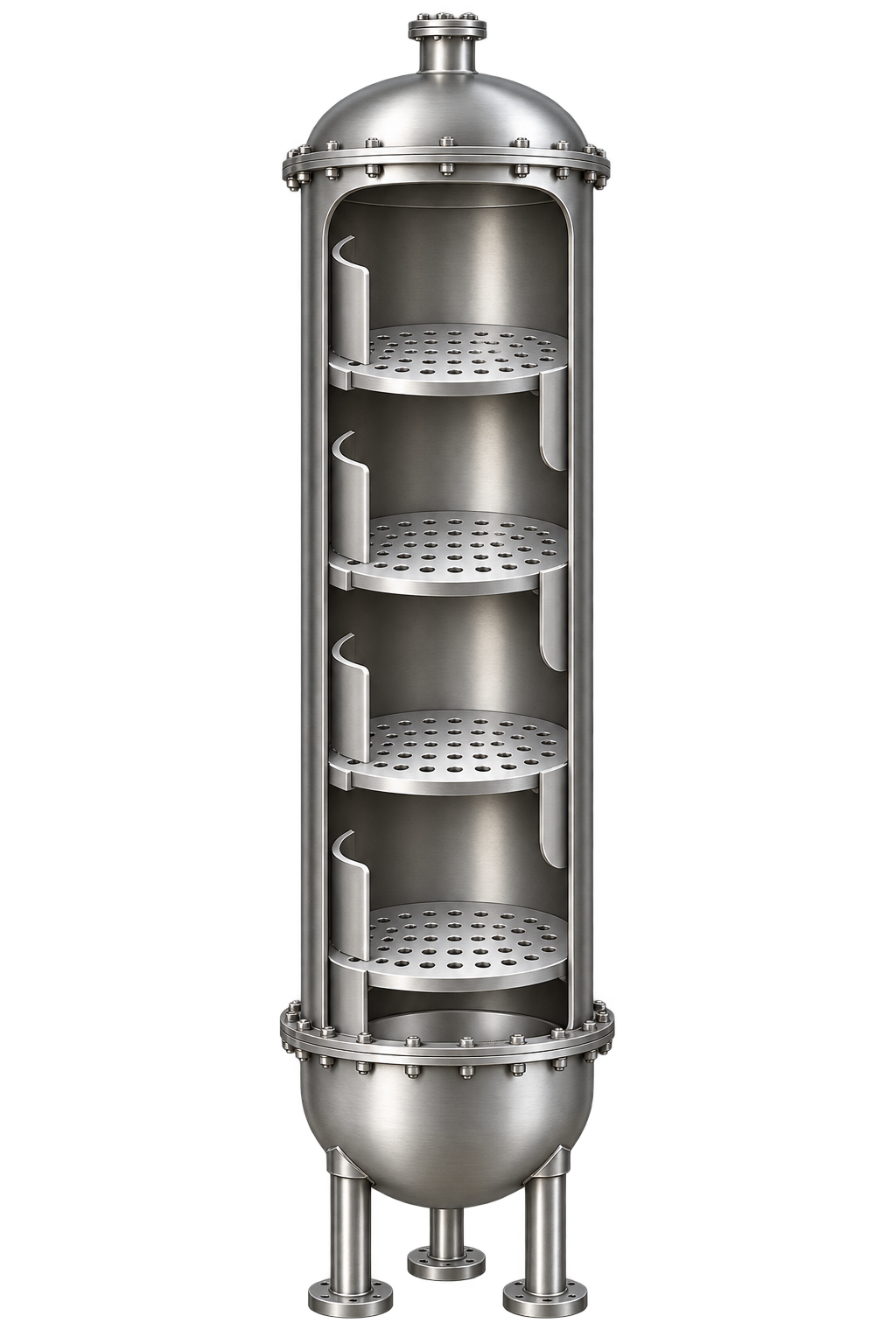
WHAT HAPPENS TO THE TRAYS?
On a sieve tray, sufficiently low vapour flow allows liquid to leak through the holes. More severe drainage is called dumping. As conditions change, liquid redistributes through the column; the transient matters even if the final steady state looks familiar.
The liquid and vapour already inside the column, drum and reboiler can keep changing after a motor stops.
Steam does not universally remain on. Valve fail positions and shutdown systems determine how heat input changes.
Total reflux can be part of a restart strategy. The sequence and duration are specific to the plant and its operating procedures.
THE TEXAS EXAMPLE · FEBRUARY 2021
Bloomberg reported that Exxon Mobil’s Baytown ethylene facility reported nearly one ton of benzene and 34 tons of carbon monoxide during the freeze. Those are facility emissions from reported events, not a measured release from the illustrative distillation column on this page.
Read the Bloomberg report, republished by EnergyNow on February 22, 2021.
STEADY STATE → DYNAMICS
A steady-state balance does not describe how inventory changes with time. A dynamic assessment adds holdups, equipment response and control or protection behaviour. Validate it against suitable measurements, tests and operating evidence, with engineers reviewing the assumptions and limits.
Sources: KLM relief-valve design guideline; KLM tray-hydraulics guideline; Staak et al., simulation and experimental analysis of operational failures. The illustration is educational and is not a substitute for the plant’s design basis.
RARE LABS
We are building an autonomous scale-up system for chemistry using robotics and AI, starting with peptides and pharma.