
ENGINEERING EXPLAINED
Close the cooling balance.
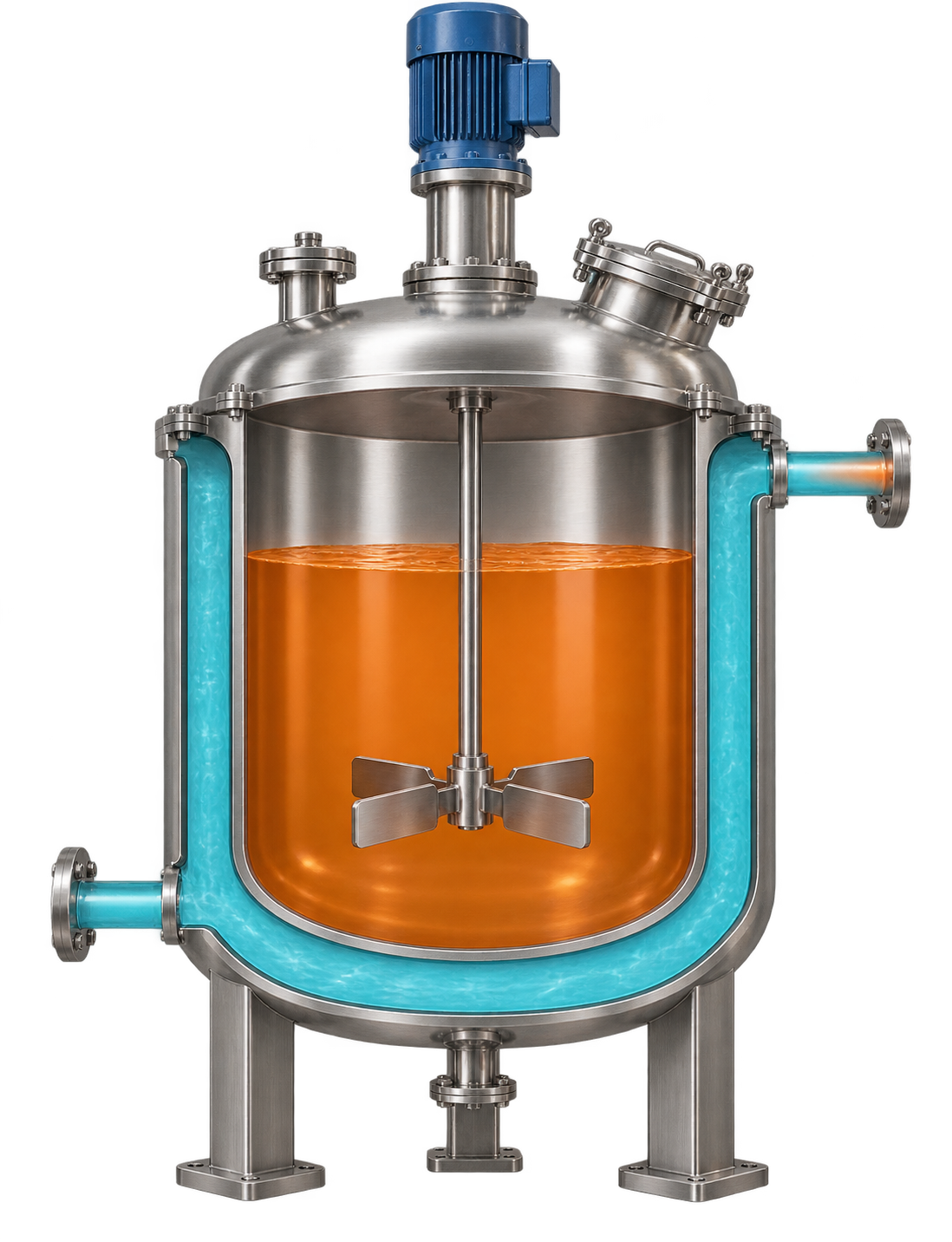
Follow the heat through the wall and into the coolant. Watch the outlet warm and the driving temperature gap shrink.
By Nathan, chemical engineer and co-founder of RARE Labs.
CLOSE BOTH SIDES
Let the outlet temperature be a result.
42 kW is an energy balance, not an equipment rating.
One kilogram per second of coolant with a heat capacity of 4.2 kJ/(kg K), warming by 10 K, gains 42 kW. Whether the jacket can transfer that heat depends on the temperature driving force and its conductance, as well as the reactor-side balance.
Ċ = ṁcₚ; NTU = UA/Ċ
T_out = T_R − (T_R − T_in)exp(−NTU)
Q = Ċ(T_out − T_in) = UA ΔT_lm
This example assumes steady single-phase plug-flow coolant around a well-mixed reactor held at uniform temperature. Heat capacity and overall UA are constant, with no wall accumulation or external heat loss. A perfectly mixed jacket needs a different balance. Actual UA may vary with flow, geometry, fouling and properties; the controls isolate effects rather than rate equipment.
A constant coolant temperature can be a reasonable approximation for negligible warming, a large regulated reservoir or appropriate phase-change service. Compare the assumption with the actual utility. This tool does not establish safe reaction duty or cooling-system capacity.
Primary sources: University of Michigan — reactor and coolant balances · USPAS / Fermilab — exponential temperature profile and LMTD.
RARE LABS
From lab chemistry to production.
We are building an autonomous scale-up system for chemistry using robotics and AI, starting with peptides and pharma.