
Engineering explained / NOWHERE
Three things
choose the address.
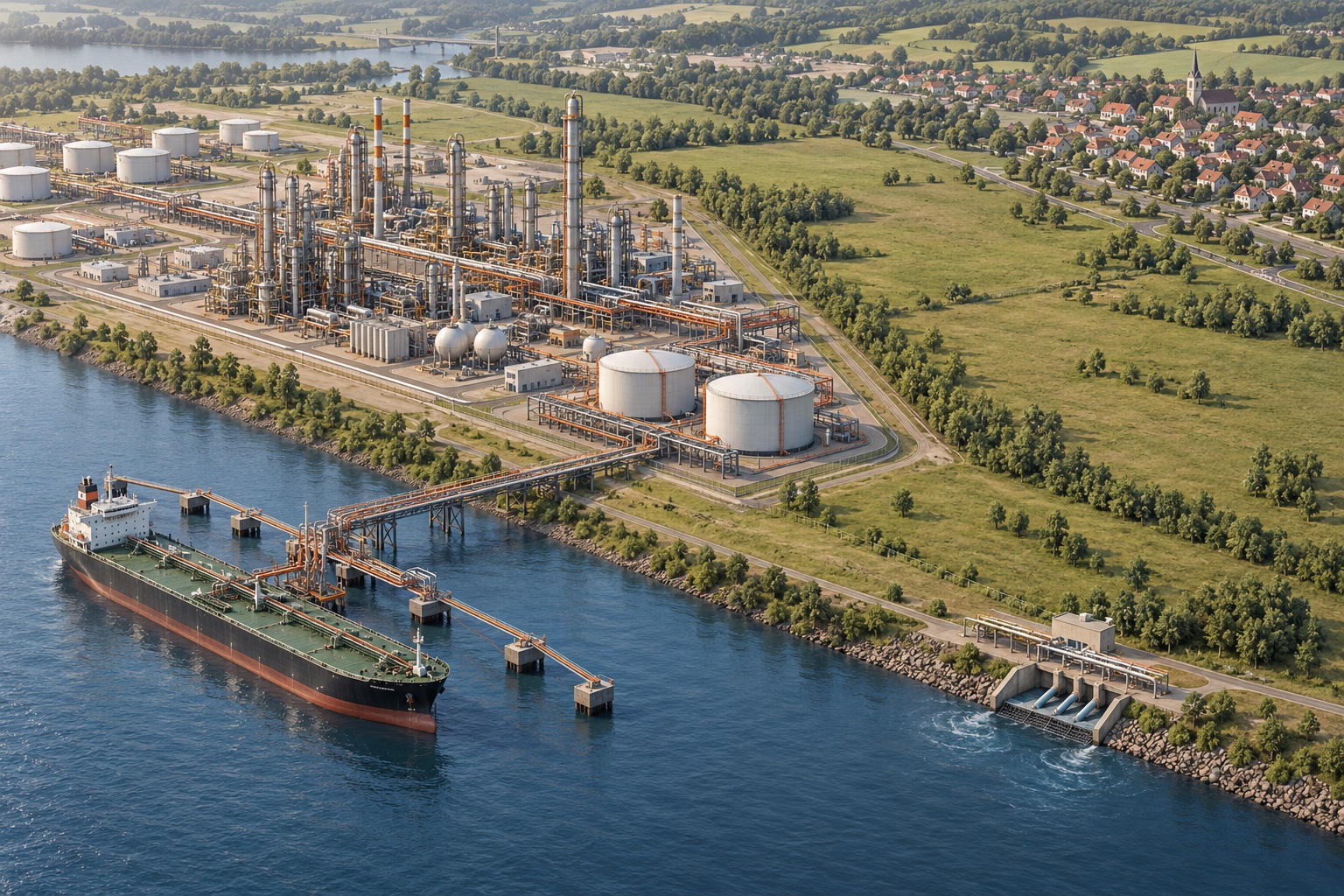
The river. The feed. The gap. The land under a chemical plant is part of its process.
01 / Feed
Cheap per tonne.
Expensive to move.
Bulk plants need dependable ways to move large material flows. A port, rail connection or pipeline can matter more than the price of the land. Trucks remain useful, especially for smaller deliveries. The economic question is which transport system fits the throughput.
02 / Heat
The heat has to go somewhere.
Cooling water absorbs process heat without mixing with the process stream. In a once-through arrangement, water is drawn from a source, warmed in exchangers and discharged. In a recirculating arrangement, the cooling circuit reuses water and rejects heat elsewhere.
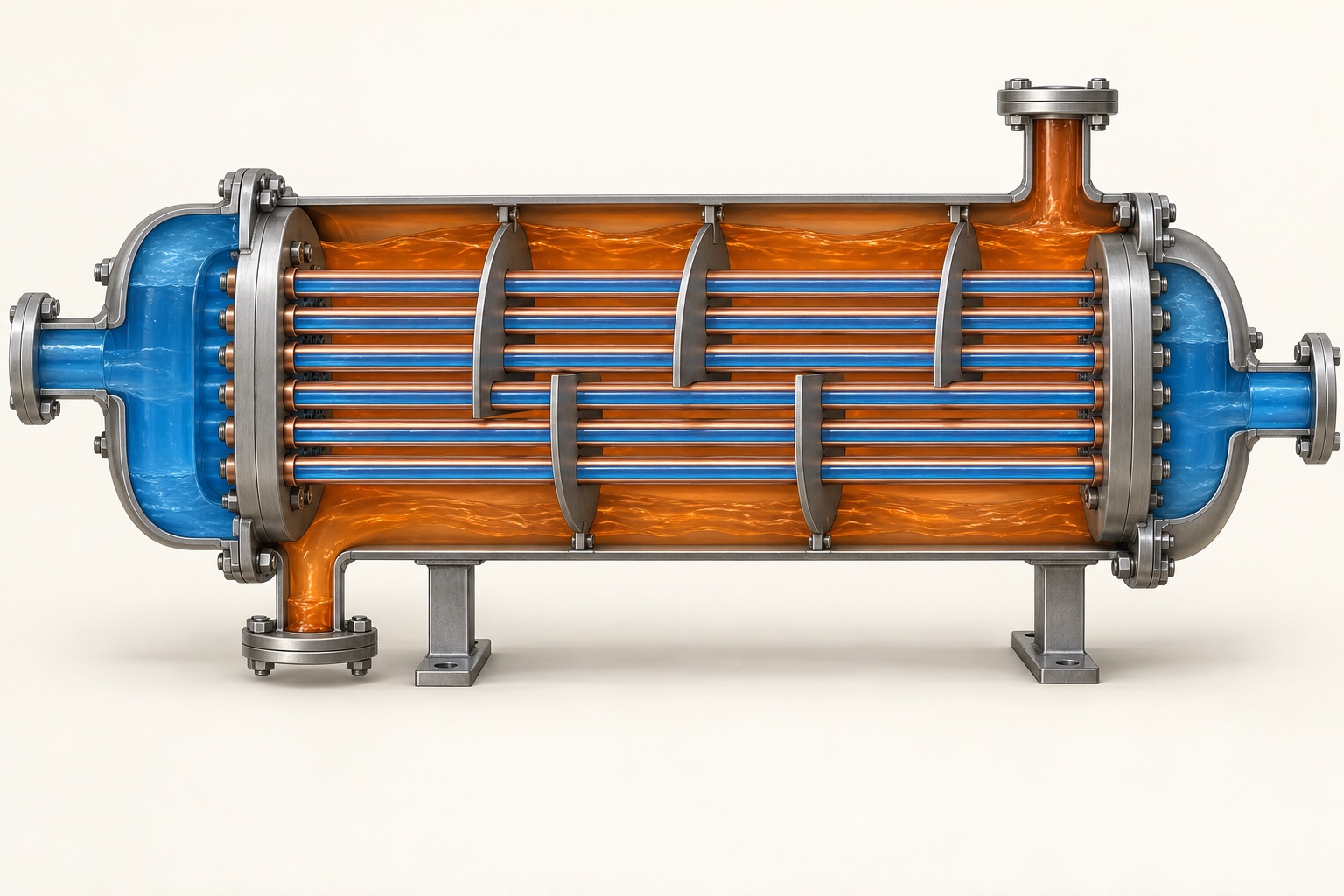
For a once-through example, this is the ideal cooling withdrawal. It is not water consumption, and it is not the makeup demand of a cooling tower.
Equation, units and assumptions
Flow [L/s] = Q̇ [MW] × 1,000 / (4.184 × ΔT [°C])
Water density is approximated as 1 kg/L and heat capacity as 4.184 kJ/(kg·K). All selected duty goes to this water stream at steady state. Sum condenser, cooler and other duties before entering the total. The calculation excludes pumping losses, fouling, exchanger sizing and discharge limits. Doubling duty doubles flow; doubling temperature rise halves flow.
The reel’s about 2,500 L/s is a historical example: a 1963 USGS report cites a 1952 estimate of roughly 40,000 US gallons per minute for a 50,000-barrel/day refinery, allowing for other water uses and a 30°F cooling-water rise. It is not a universal demand for modern refineries. USGS source.
A river is one option. Coastal supplies, reclaimed water, recirculating towers and air cooling can change the location constraint. “No river, no plant” is the reel’s shorthand for the once-through example, not a general siting rule.
03 / Distance
The gap does a job.
Separation protects neighboring land uses from industrial impacts. Its basis can include noise, air emissions, odor and credible accident consequences. Those are different assessments. A planning setback is not automatically a blast-safe distance.
These are Ontario D-6 land-use compatibility reference distances for Class III industry, subject to the guideline’s site-specific provisions. The 1,000 m area is a screening influence area. Neither number is a universal explosion radius. Read the guideline.
In West, Texas, the 2013 fertilizer storage explosion killed 15 people. The closest school was about 550 feet away. The CSB’s investigation identifies land-use planning and zoning among its central issues. The lesson is not that one generic radius solves siting; it is that the surrounding community belongs in the hazard assessment. CSB final report.
The exception / Different economics
A smaller truck can change the map.
Low-volume, high-value products such as pharmaceuticals can carry their transport costs differently from bulk commodities. That gives some facilities more location flexibility and makes proximity to skilled workers more attractive. It does not exempt pharmaceutical manufacturing from zoning, solvent hazards, emissions controls or local approvals.
Then the neighbors become useful
One plant becomes a cluster.
A neighboring facility can offer a useful feedstock, utility connection, pipe route or skilled workforce. Sarnia-Lambton’s economic partnership documents its integrated network. EIA’s 2025 Gulf Coast figure measures refining capacity, not the share of oil refined on every day. Sarnia-Lambton · EIA.
Read the underlying work
Sources and boundaries
- Northwestern process-design reference: transport, utilities, product value and other site-selection factors.
- USGS Water Supply Paper 1330-G: historical refinery water-use survey.
- Ontario D-6-3 diagrams and D-6 guideline: land-use compatibility.
- CSB West, Texas final investigation: incident findings and land-use context.
- Sarnia-Lambton Economic Partnership and EIA (2025): cluster infrastructure and refining-capacity figures.
This page teaches a heat balance and siting considerations. It does not choose a safe site, calculate a blast distance, establish an allowable withdrawal, or replace a site-specific engineering and regulatory assessment.
Nathan Ruberto · Reflux
Explore the engineering library →