Natural uranium
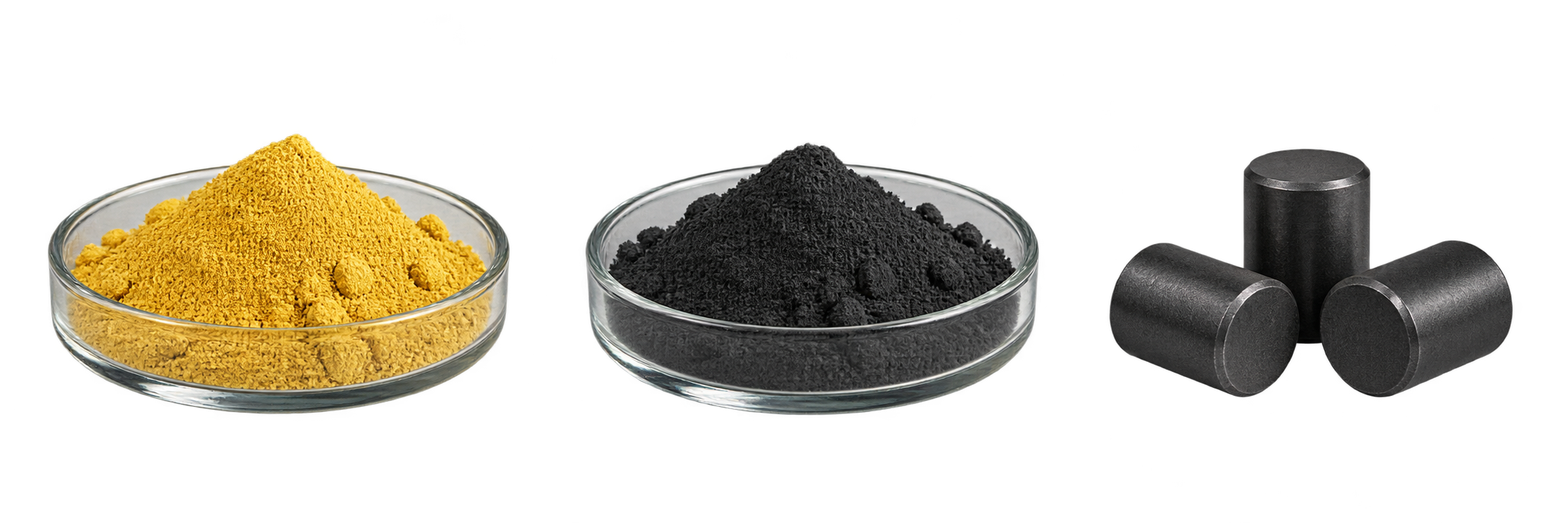
Conventional CANDU fuel can use natural uranium. Ceramic uranium-dioxide pellets are contained in metallic fuel elements assembled into bundles.

ENGINEERING EXPLAINED / YELLOWCAKE
A visual guide to uranium material forms, reactor routes and the phase change in the video.
By Nathan, chemical engineer and co-founder of RARE Labs.
FOLLOW THE MATERIAL
Uranium concentrate is an upstream material. Fabricated fuel has a specific chemical form and physical structure chosen for the reactor. Select a stage to see what changes.
Illustrative materials; color and composition vary. Not an operating procedure.
01 / CONCENTRATE
Mining and milling produce a concentrated uranium product. The familiar yellowcake name covers concentrates with differing oxide compositions and appearances; it is not a universal purity specification.
It still has to be converted and fabricated into fuel.
Fuel-cycle context: U.S. EIA, the nuclear fuel cycle.
THE PHASE CHANGE IN THE VIDEO
UF₆ sublimation at atmospheric pressure
Sublimation means solid → gas. It is not a universal boiling point.
Uranium hexafluoride is useful in the civil fuel cycle because it can be handled in a gaseous form. Its physical state depends on pressure as well as temperature.
Fluorine has one stable isotope. Different isotopic masses in UF₆ therefore arise from the uranium, rather than a mixture of stable fluorine isotopes.
Source: World Nuclear Association, conversion and deconversion.
Conventional CANDU fuel can use natural uranium. Ceramic uranium-dioxide pellets are contained in metallic fuel elements assembled into bundles.
Many common power-reactor designs use uranium whose isotopic composition has been changed before final fuel fabrication. This is a distinct step from shaping the fuel.
A material balance tracks quantities. Powder handling, compact integrity and scale-dependent behavior also require material characterization and physical evidence.
The video compresses several routes into a short explanation. “Three plants” is a storytelling shorthand: actual facilities and process arrangements differ. Not every fuel-cycle operation is a gas–solid reaction.
RARE LABS
We are building an autonomous scale-up system for chemistry using robotics and AI, starting with peptides and pharma.