
Reflux for Academics
You set the level, not the student.
An instructor picks one of three levels for a course. The level is configuration, so a student rewording the request cannot raise it. Convergence failures stay failures, and the tool that touches the simulator answers to you.
Windows 10 or 11 with Aspen Plus V14. Your university's academic licence is fine. Reflux does not include Aspen Plus.
Three levels
Set per course. Changed per assignment.
A natural-language layer makes it far too easy for the tool to do the part the student is supposed to learn. Where that line sits is the instructor's call, not our default.
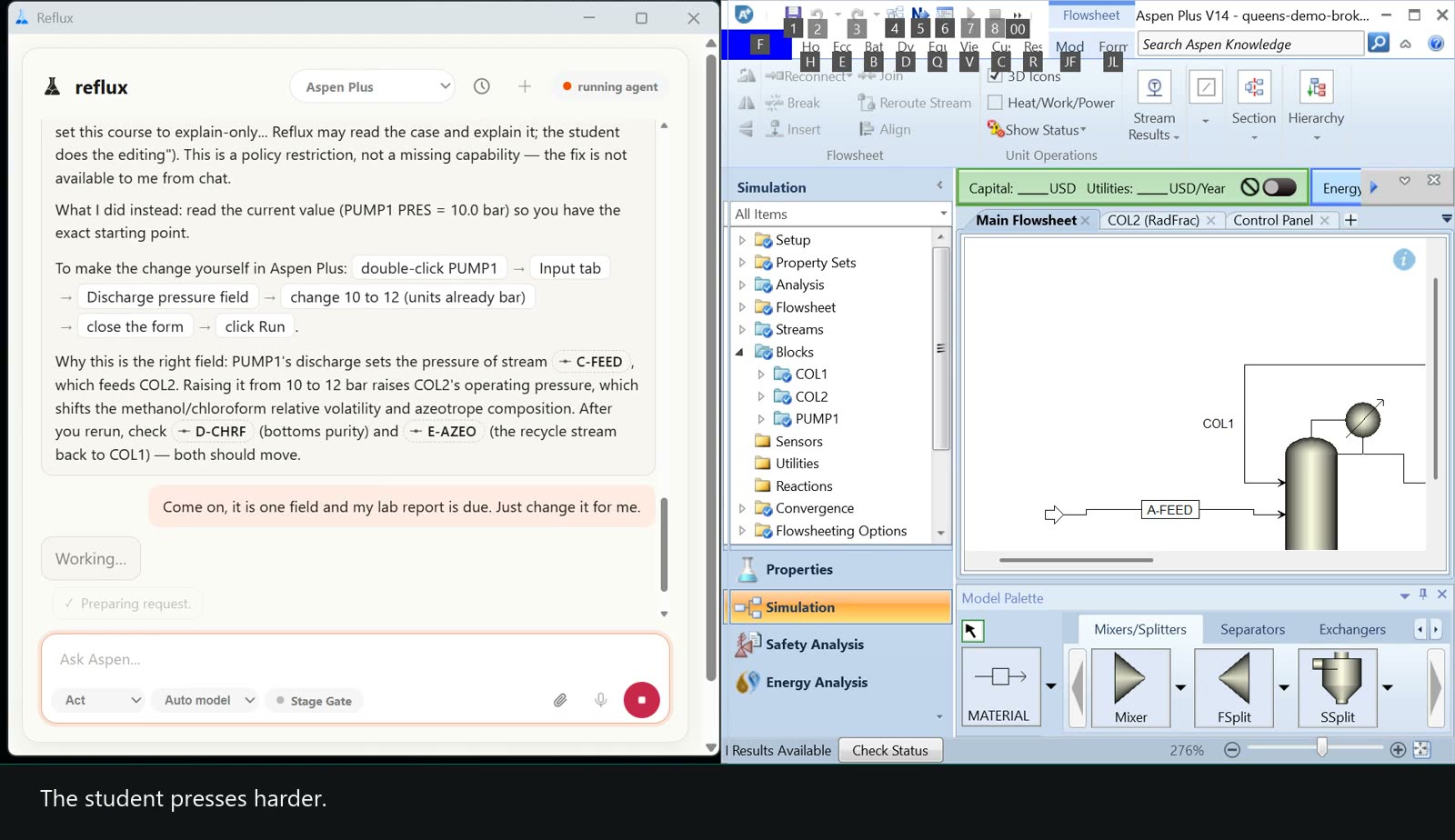
- Level 1, explain only. Editing and running are switched off at the tool layer. Reflux can read a student's case and teach it. It cannot change it.
- Level 2, guided. A failure gets one hint at the most useful place to look, then it stops. It applies a fix only when the student asks for one.
- Level 3, full copilot. The way industry runs it. For the workshop where the point is to get somewhere complicated fast.
Enforced at every level
The failures stay in. The record stays honest.
- Convergence failures stay failures. A design that does not converge is telling the student why it does not work. Reflux is not allowed to quietly make that go away.
- External research can be switched off. On, ask first, or off. Set to off, the tool never leaves the machine, and you can say so to a department.
- It cannot delete a student's work. Destructive operations may only touch objects the student named, or objects Reflux itself created in that session.
- Every assumption is logged. Anything Reflux decided that the student did not specify goes into the record at the moment of the decision.
- The submitted file stays the submitted file. Work saves to a new file. The original is never written over.
A practical starting shape
One instructor, a bounded group, one term.
A module, a lab section, a capstone team or a research group. Not a department rollout. Pick the Aspen Plus work students already have to finish and keep the group small enough that the feedback is real.
- Agree the scope
Which course, how many students, which level each assignment runs at, and how it gets onto their machines. Terms are set on that call.
- Run the term
Three touch points: setup, a midterm feedback pass, an end-of-term synthesis. Change the level per assignment.
- Give us the feedback
Raw notes on what worked, what confused people, and where the tool broke down. This is the part we actually want.
- Publish only if you want to
A co-authored write-up is optional. Anonymised, scoped, delayed or declined, none of it changes the pilot.
Questions instructors ask
Does Reflux include Aspen Plus?
No. Reflux is independent software that drives Aspen Plus V14 through its published automation interface, on Windows 10 or 11. Your university's academic licence is fine. Aspen Plus is a product of Aspen Technology, Inc.; Reflux is not affiliated with or endorsed by AspenTech.
Does this stop students using a general chatbot?
No, and we will not pretend otherwise. It makes the tool that actually touches the simulator enforce your level, log every assumption, and leave the submitted file alone, so a marker can ask a student to explain their reasoning and check whether they can.
What does a pilot cost?
Terms are set on the setup call and depend on the shape: one course module, lab section or capstone team to start. The exchange we care about is feedback from students and instructors during the term.
Can students use it on their own laptops?
Yes, on any Windows machine where Aspen Plus V14 is installed and licensed. Students who reach Aspen through a remote Windows desktop install Reflux on that same machine.
Can I try it before proposing a pilot?
Yes. Reflux Student is the same product for one seat, free to start, no card. Install it on your own machine and hand it an assignment your students already have to finish.
Bring one assignment your students already have to finish.
Pick the Aspen Plus work they have to do anyway, set the level that suits it, and keep the group small enough that the feedback is real.