
THE SPACE THAT BUYS TIME
Half empty.
Full of purpose.
A process drum absorbs the difference between what comes in and what leaves. The useful question is how long that space gives you to respond.
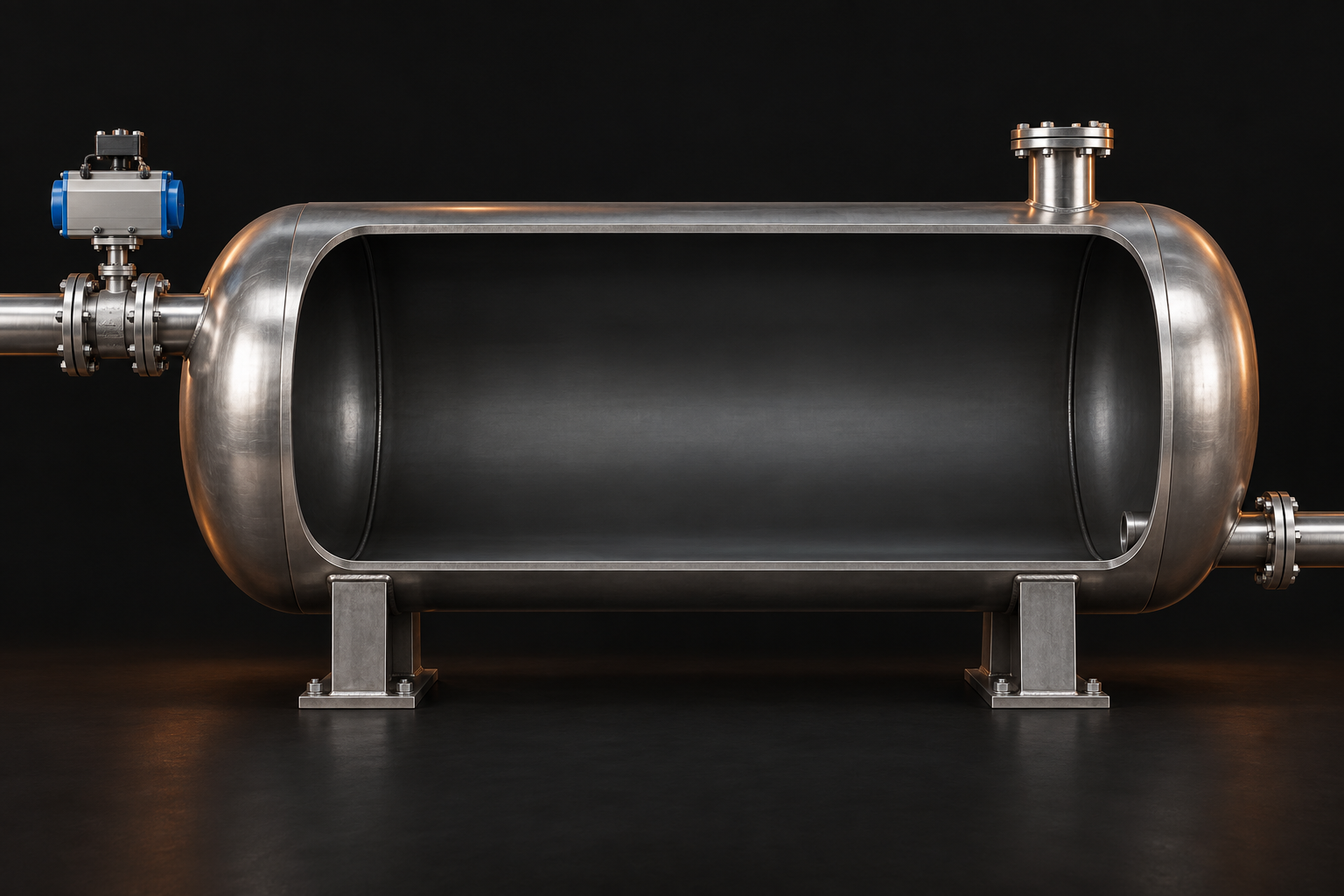
A visual guide to process drums. Half-full is a reflux-drum rule of thumb, not a universal tank operating limit.
REFLUX FOR YOUR WORK
Keep the sizing connected to the model.
Join the Reflux trial waitlist. Tell us which simulator you use, and we’ll email you about availability.
Aspen Plus on Windows? Try Reflux Student →This guide is free to explore without signing up.
01 / THE DRUM IS A BUFFER
Give the imbalance somewhere to go.
Drag the controls. More holdup makes a bigger vessel. A larger flow mismatch uses the same spare volume faster.
Inflow exceeds the 100 L/min outflow. The drum accumulates 20 litres each minute.
100 L/min × 5 min = 500 L
(120 − 100) L/min × 0 min = 0 L
What the model assumes
Constant density, a fixed 100 L/min outlet demand and a normal inventory of 50% of total volume. High alarm is illustrated at 65% and high-high at 75% of volume. No controller or shutdown action is simulated: reaching high-high flags the need for action, it does not stop filling here. The clock reports remaining time at the selected net flow. Below the illustrated 8% dead-volume boundary, the fixed outlet demand can no longer be supplied and liquid remains trapped; above 100%, excess liquid spills.
The liquid height is calculated from a horizontal circular-cylinder area, then mapped onto the cutaway artwork. Dished-head volume is omitted. These are educational examples, not operating setpoints or a vessel design calculation.
02 / FOUR JOBS, ONE VESSEL
Every band earns its space.
Headspace leaves room for vapour disengagement and liquid expansion. Its requirements depend on the service.
Surge provides a response window above the normal operating range. Alarm and trip settings must account for how fast inventory can change and how long the final element takes to act.
Working liquid supports the normal process and control range. Define the inventory used in your holdup-time calculation.
Dead volume sits below the effective outlet or minimum usable level. Geometry, drainage and outlet submergence matter.
This example totals 100%. It is an allocation by volume, not equal-height bands or universal percentages. The 5–10% dead-volume and 20–30% headspace ranges mentioned in the video are rough starting points. Final allowances depend on the equipment and duty.
03 / START WITH TIME, CHECK THE SERVICE
Five minutes is a starting point.
Published rule of thumb for a reflux drum at half-full inventory.
Rule of thumb for a product drum feeding another tower.
These heuristics do not establish alarm settings or prove separation performance. Check the operating envelope, upset flows, usable inventory, vapour disengagement and control response. Source: Ludwig’s rules-of-thumb summary, vessels (drums) ↗
Propane needs expansion room, too.
A motor-fuel tank’s overfill protection device uses a float to shut the fill path at its intended limit. The remaining space accommodates liquid expansion as temperature rises. This is a different service and protection system from the process drum above. DOE-hosted technical presentation ↗
04 / 11 DECEMBER 2005 · NORTH OF LONDON
The display stopped.
The filling didn’t.
A fuel depot lost both its normal level indication and its independent overfill protection. The investigation’s sequence:
Gauge flatlines
The displayed level stops rising while petrol continues entering. Alarms relying on that reading cannot see the true level.
Roof vents overflow
The tank exceeds capacity. The independent high-level switch has also failed to trigger shutdown.
Explosion
The fire alarm is raised and the explosion follows almost immediately. More than 250,000 litres have escaped by this point.
Independent hardware still needs a working maintenance system.
The backup switch required a padlock to hold its test lever in the operating position. That requirement was not properly communicated; the lever could be left or fall into a disabled position. The gauge had also stuck repeatedly before the incident.
05 / THE SIMULATION IS NOT THE INVENTORY
A balanced flowsheet
doesn’t size the buffer.
A steady-state mass balance sets accumulation to zero. It does not, on its own, determine the liquid inventory needed to handle an upset. Some simulator models allow geometry, holdup or dynamic specifications; check what your chosen model actually represents.
Carry the flow case, residence-time basis and protection assumptions into the equipment sizing. Keep them visible when the process changes.