ENGINEERING EXPLAINED / HAMMER
Breaks when
it stops.
Your pump pressure is only the beginning. Stop a moving liquid column and the pressure wave gets there first.
for a 2 m/s stop in this example
REFLUX FOR YOUR WORK
Your next model. With Reflux.
Join the Reflux trial waitlist. Tell us which simulator you use, and we’ll email you about availability.
Aspen Plus on Windows? Try Reflux Student →The water-hammer lab below is free. No signup needed.
01 / THE STOP BECOMES PRESSURE
Close the valve.
Watch the wave.
Water travels toward the valve. When it shuts, a compression front moves back upstream. Water ahead of the front is still moving; behind it, water has stopped and pressure is higher.
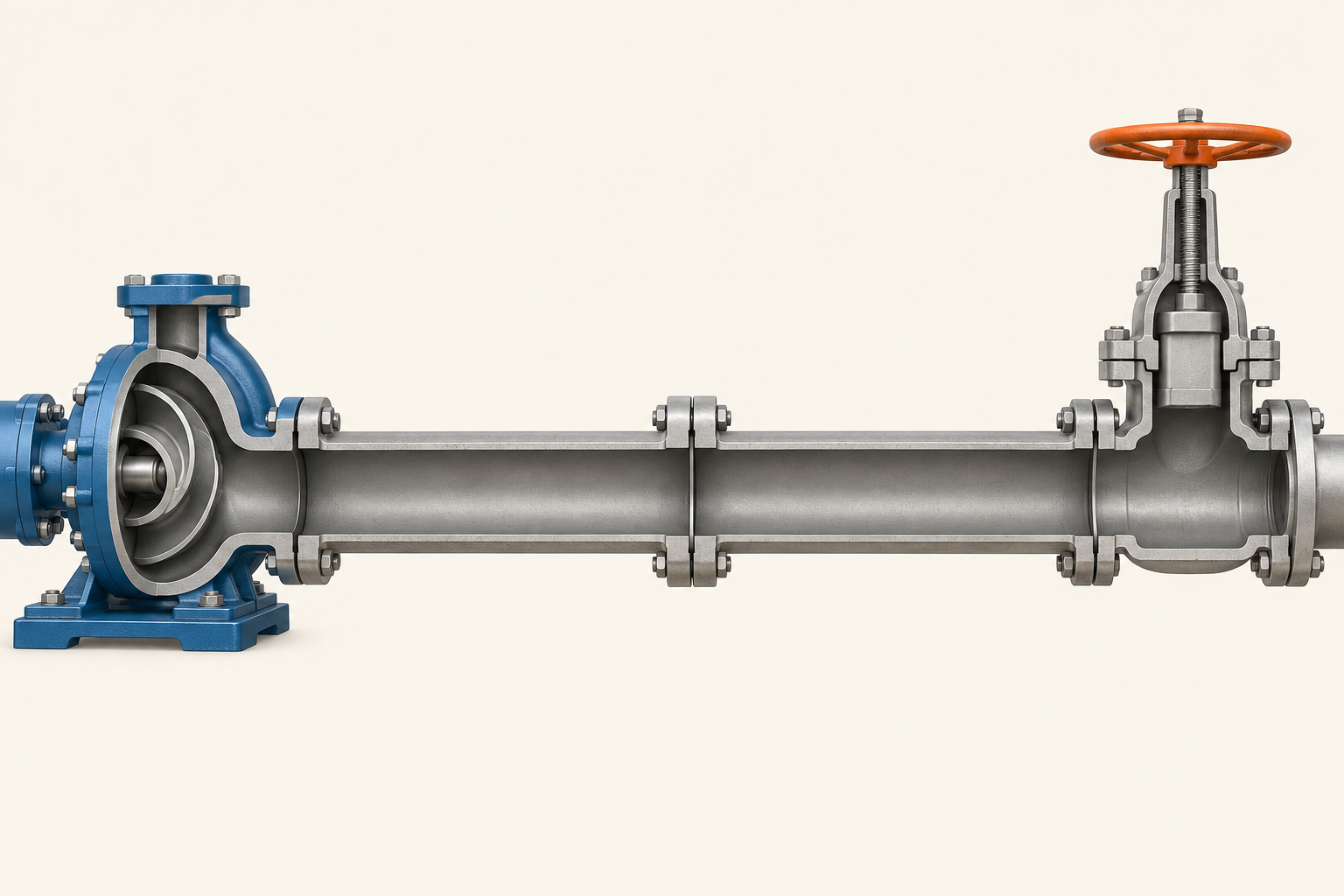
1,000 × 1,200 × 2 = 2.4 MPa = 24 bar
2 × 100 / 1,200 = 0.167 s
What this model assumes
Water density 1,000 kg/m³ and pipe–water wave speed 1,200 m/s, chosen to reproduce the video's rounded example. Actual wave speed depends on liquid compressibility, pipe material, diameter, wall thickness, restraint and gas content. The graphic slows the wave for visibility. It shows the first compression front only; the pressure trace is an ideal rapid-closure envelope, not a method-of-characteristics simulation.
For closure time longer than 2L/c, the full Joukowsky rise is shown as a reference only and the rapid-closure trace is hidden. A longer closure usually reduces the surge, but 2L/c is not a safe operating limit or a guarantee: valve characteristics, the network, reflections, pump trips and column separation need transient analysis.
The 19.6 bar(g) comparison is a representative ASME B16.5 Class 150 carbon-steel flange rating at ≤38°C. Class, material and temperature must all be specified. Compare the total transient pressure, not just its increment, with the relevant equipment rating. This is an educational model, not a piping design approval.
02 / TWO WAYS STEAM HITS
Gas moves the liquid.
Or disappears between it.
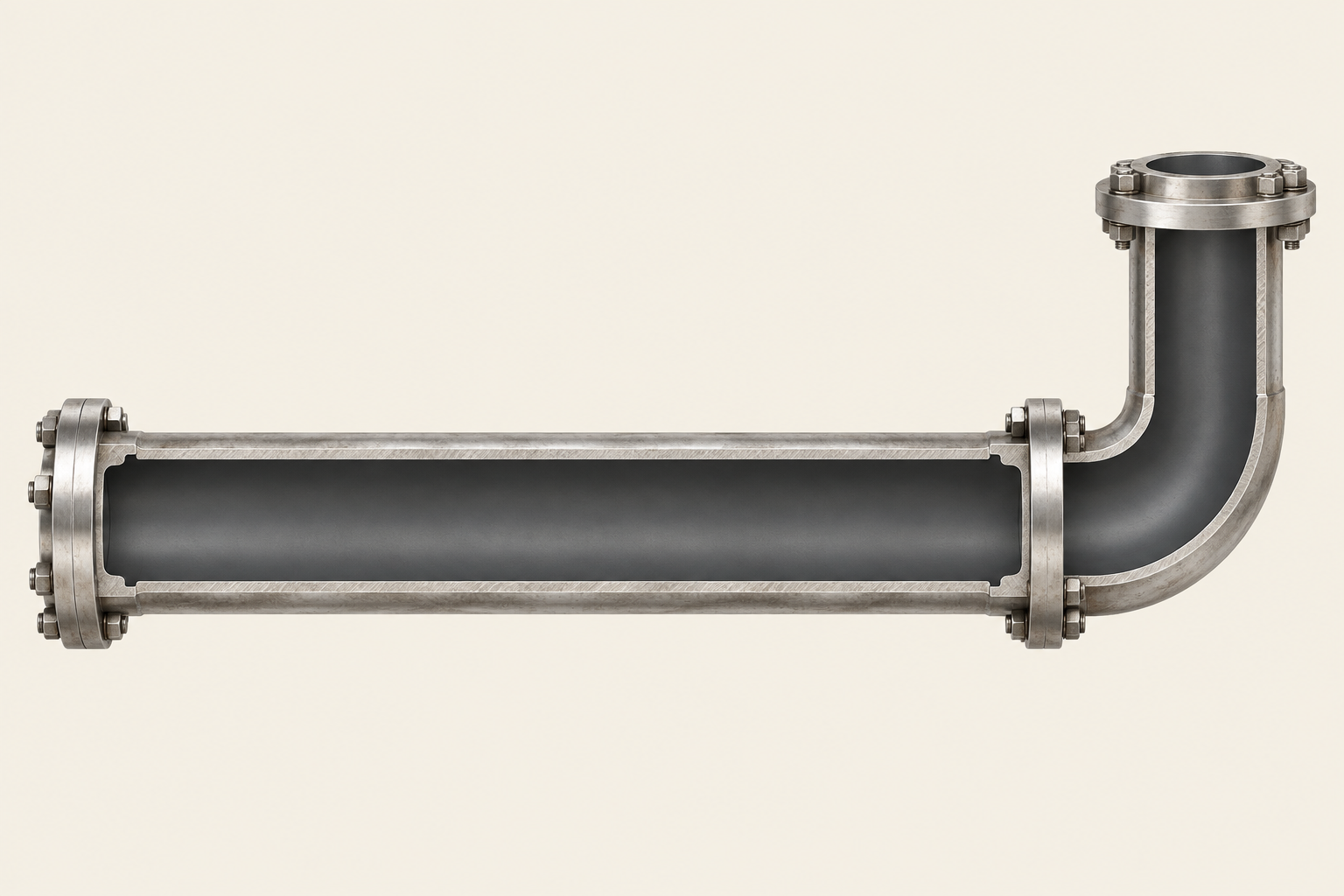
Fast steam drags condensate into a slug. The liquid hits the elbow and loses momentum.
Spirax Sarco describes steam speeds up to 145 km/h carrying condensate. In the second mechanism, steam condenses to liquid with more than a thousandfold reduction in specific volume; the surrounding liquid rushes into the collapsing space. These mechanisms need drainage and correct operating sequences, not just a stronger pipe. Spirax Sarco ↗ · TLV ↗
03 / A RESTART WITH CONSEQUENCES
A 12-inch line.
32 hospital admissions.
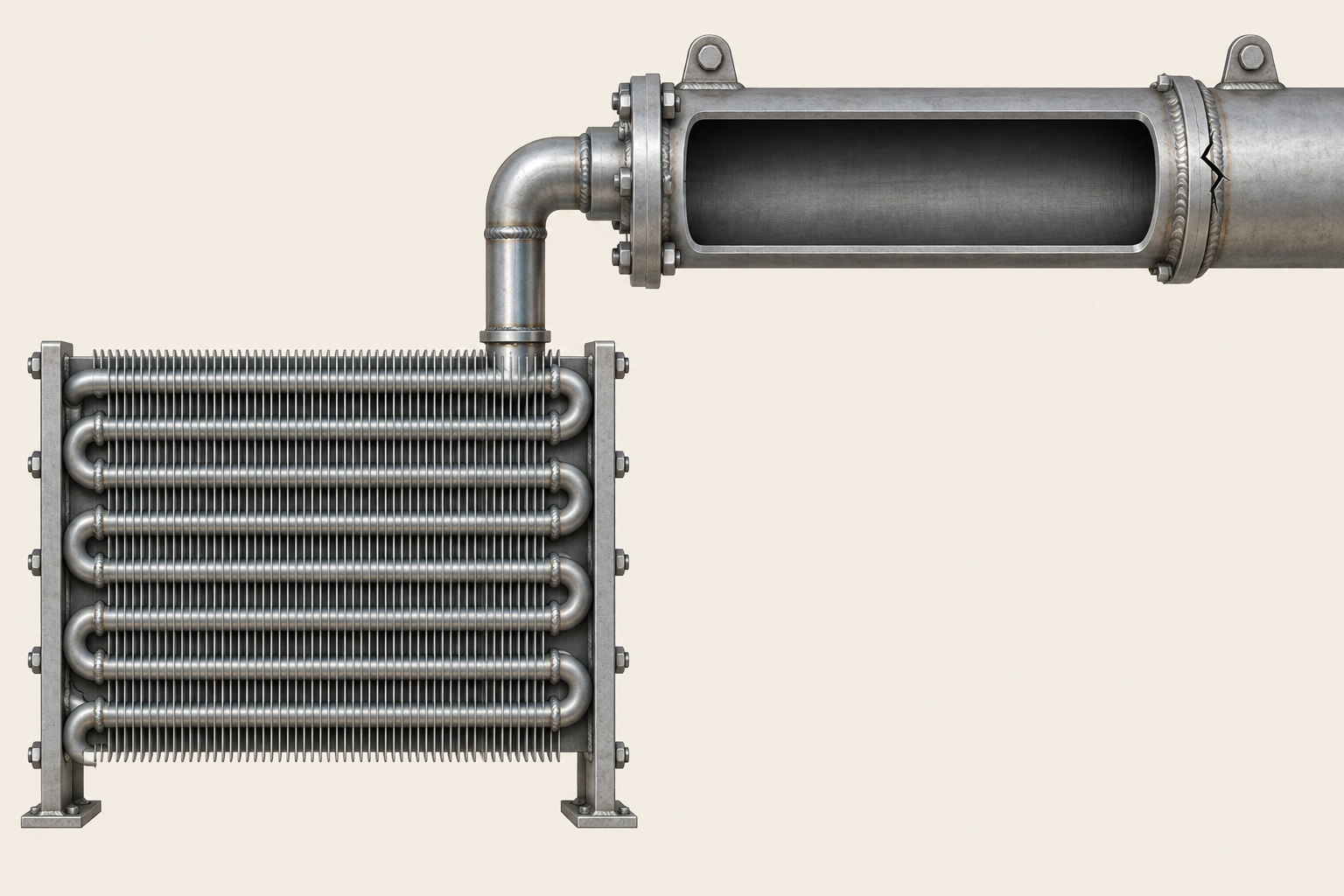
A 2010 ammonia-refrigeration restart interrupted hot-gas defrost. Hydraulic shock ruptured an evaporator and a large suction pipe. The CSB bulletin records 32 hospital admissions, four requiring intensive care. Its lessons include controlled depressurisation before reopening the suction path and protecting the defrost sequence from improper interruption.
Illustrative equipment, not an exact incident reconstruction. Read the CSB safety bulletin ↗
04 / WHAT THE FLOWSHEET MISSES
Steady state has no
“just after.”
A steady-state pipe block can calculate the operating pressure drop. By itself, it cannot resolve a wave travelling along the line immediately after a valve shuts or a pump trips. Use the operating case as a starting point for a transient model, with actual valve dynamics and system boundaries.
Calculation sources
KSB: pressure surges and the Joukowsky relation · KSB: Water Hammer booklet. Flange example: ASME B16.5 Group 1.1 carbon steel, Class 150 at ≤38°C; verify against the specification for your actual material and service.