
Library
One-page answers to the questions process engineers actually ask. Newest first.
HAZARDOUS AREAS
The zone map is a separate calculation.
Explore hazardous-area definitions, ignition-protection principles and the difference between stored energy and an ignition spark.
GATE VALVE
A gate is for isolation.
Move the wedge, compare valve characteristics, and see why a smaller opening is not the same as controlled throttling.
FOREVER
Where does the fluorine go?
Move beyond the filter: follow the PFAS, explore thermal-treatment conditions, and close a PFOA fluorine balance.
SERIES
SERIES — Not twice the head
Connect two pumps in series. Watch the impellers, stack the head curves, and find the real duty point on an adjustable system curve.
WATER
The water carries the heat.
Follow the liquid, watch heat cross the metal, and change the cooling target to see when a chiller is needed.
CONVERGED
Converged does not mean correct.
Close the recycle loop, change the condenser specification, and see the checks that belong between a green tick and a reported answer.
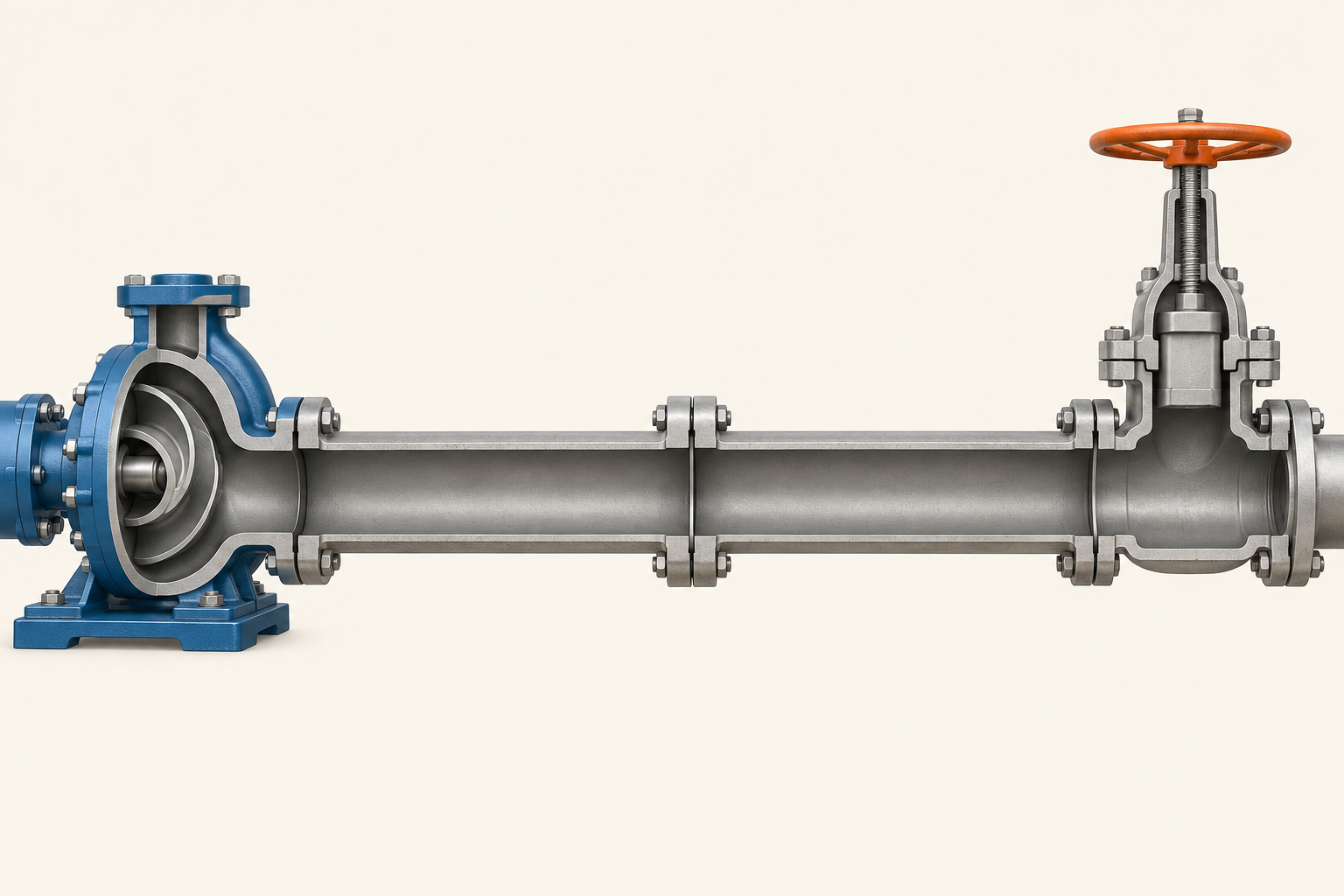 HAMMER | Water hammer explained
Stop 2 m/s of water and add 24 bar. Explore a cutaway pipe, change velocity and length, and see why valve closure time matters.
HAMMER | Water hammer explained
Stop 2 m/s of water and add 24 bar. Explore a cutaway pipe, change velocity and length, and see why valve closure time matters.
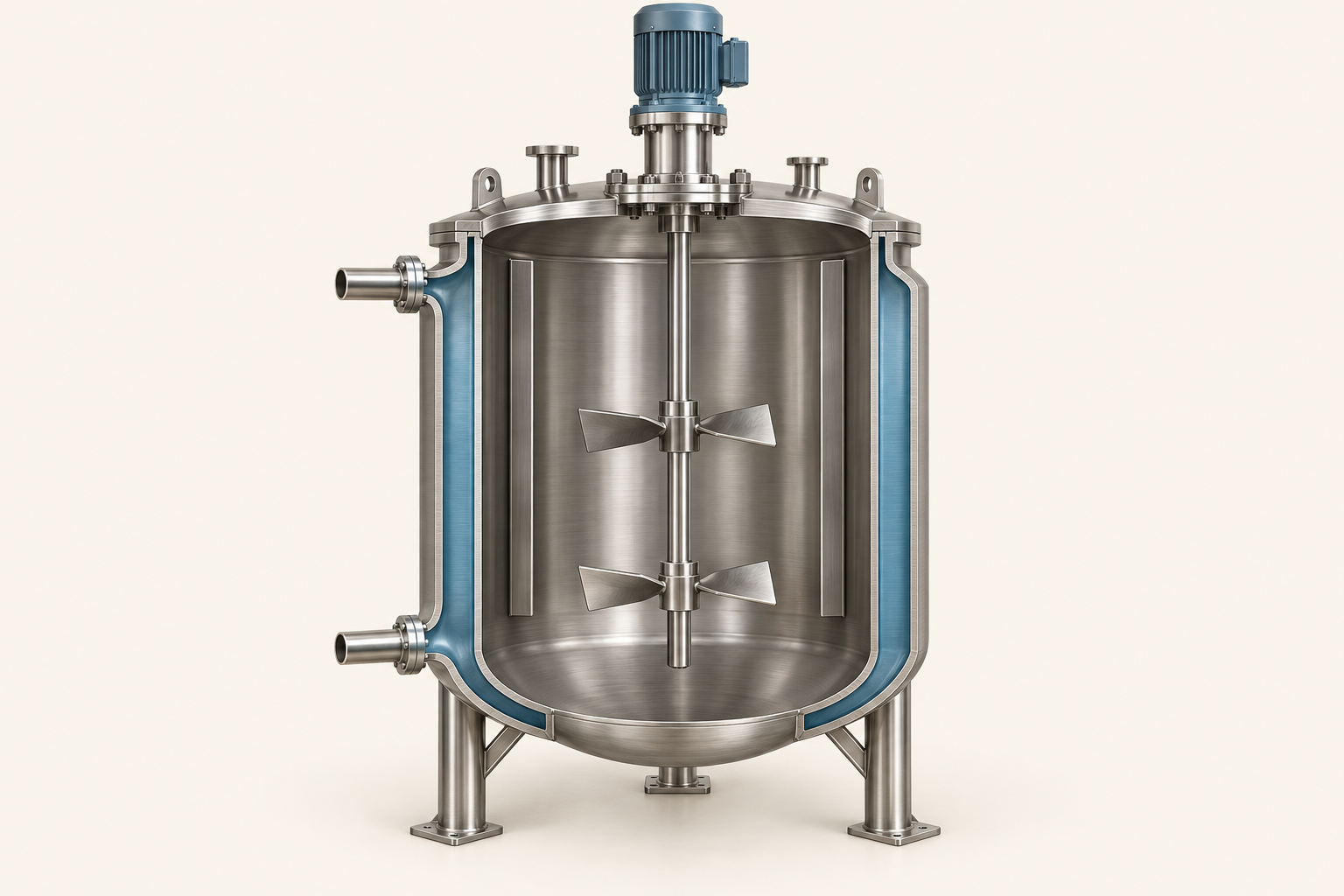 PILOT — What changes after the lab
Grow a reactor and watch jacket area per litre fall. Explore mixing, solids and the four questions a pilot plant answers, with the original 44-plant study.
DECAY
DECAY | The heat after shutdown
Shutting down the chain reaction does not stop decay heat. Explore a reactor cutaway, a decay-heat curve, and the first-day energy integral.
PILOT — What changes after the lab
Grow a reactor and watch jacket area per litre fall. Explore mixing, solids and the four questions a pilot plant answers, with the original 44-plant study.
DECAY
DECAY | The heat after shutdown
Shutting down the chain reaction does not stop decay heat. Explore a reactor cutaway, a decay-heat curve, and the first-day energy integral.
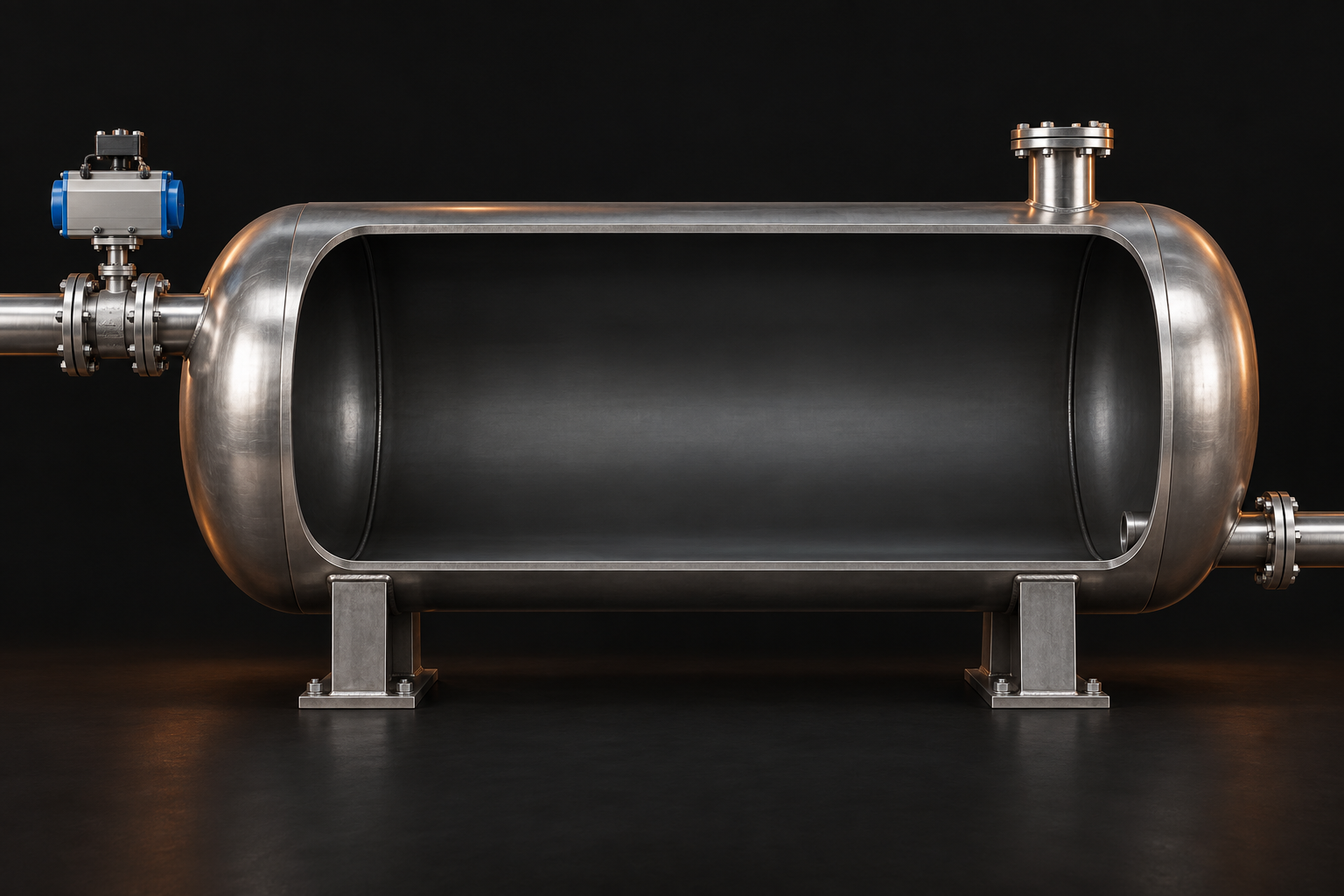 LEVEL | A drum buys you time
Explore the four jobs inside a process drum. Change flow and holdup time, watch the level move, and learn why independent overfill protection matters.
LEVEL | A drum buys you time
Explore the four jobs inside a process drum. Change flow and holdup time, watch the level move, and learn why independent overfill protection matters.
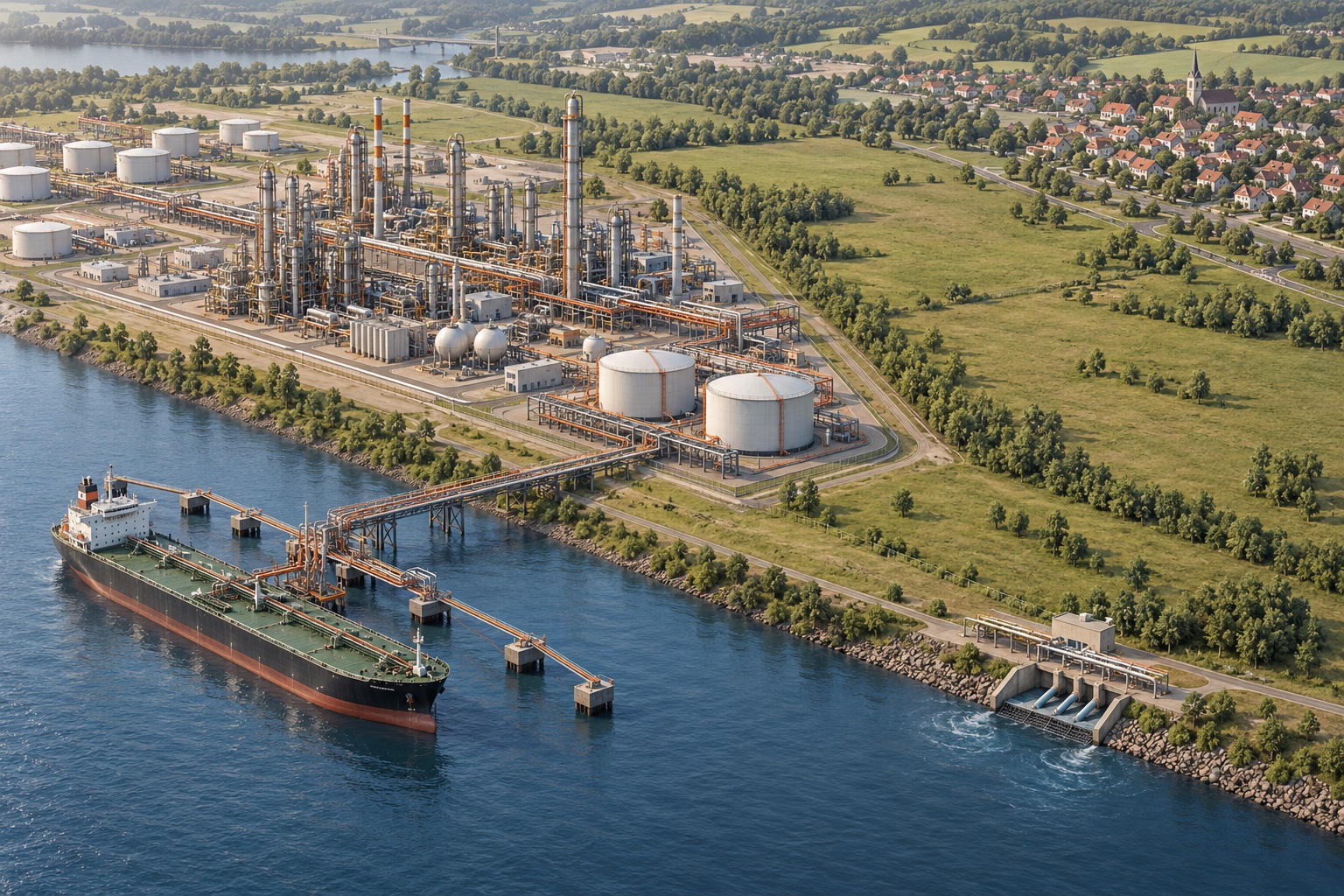 Why here? The engineering of plant siting
Why chemical plants cluster beside rivers and ports. Explore feed, cooling and separation, then turn heat duty into cooling-water flow.
Why here? The engineering of plant siting
Why chemical plants cluster beside rivers and ports. Explore feed, cooling and separation, then turn heat duty into cooling-water flow.
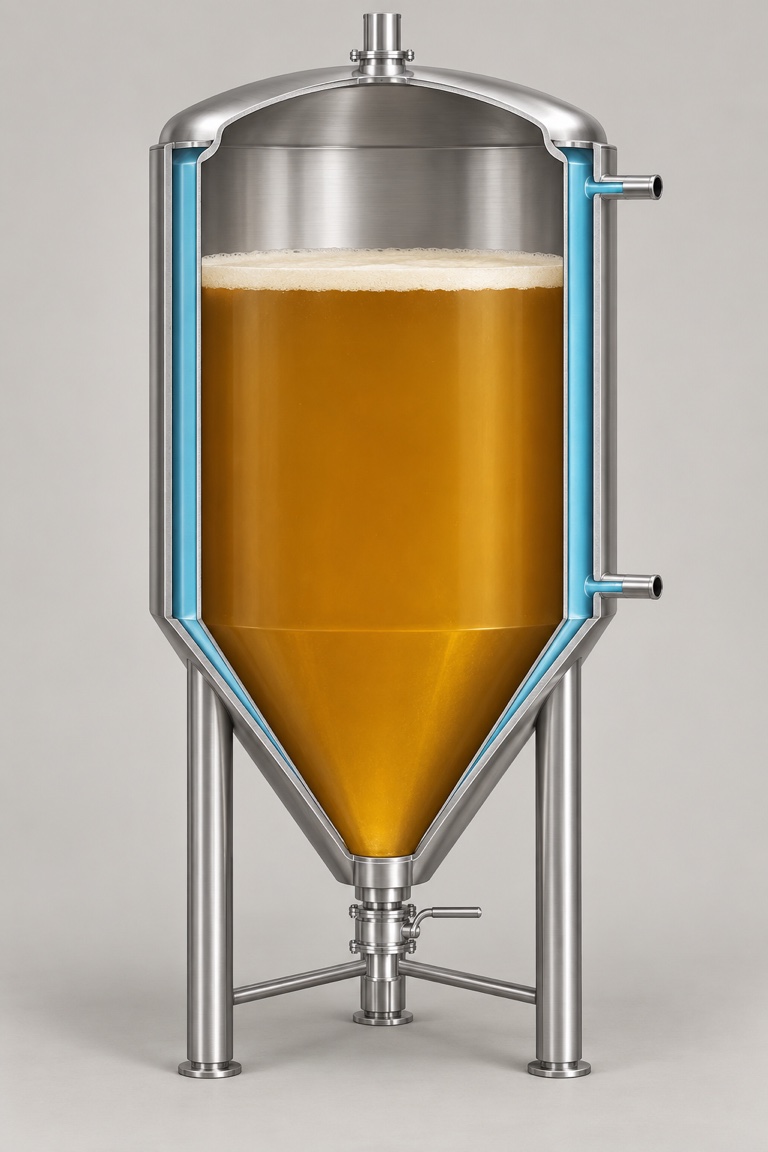 Why fermentation tanks need cooling
Grow a beer fermentation tank from 10 to 1,000 hL. Explore jacket cooling, the batch energy balance, temperature and flavour, and the CO2 count. A dedicated BREW worksheet and Reflux waitlist.
Why fermentation tanks need cooling
Grow a beer fermentation tank from 10 to 1,000 hL. Explore jacket cooling, the batch energy balance, temperature and flavour, and the CO2 count. A dedicated BREW worksheet and Reflux waitlist.
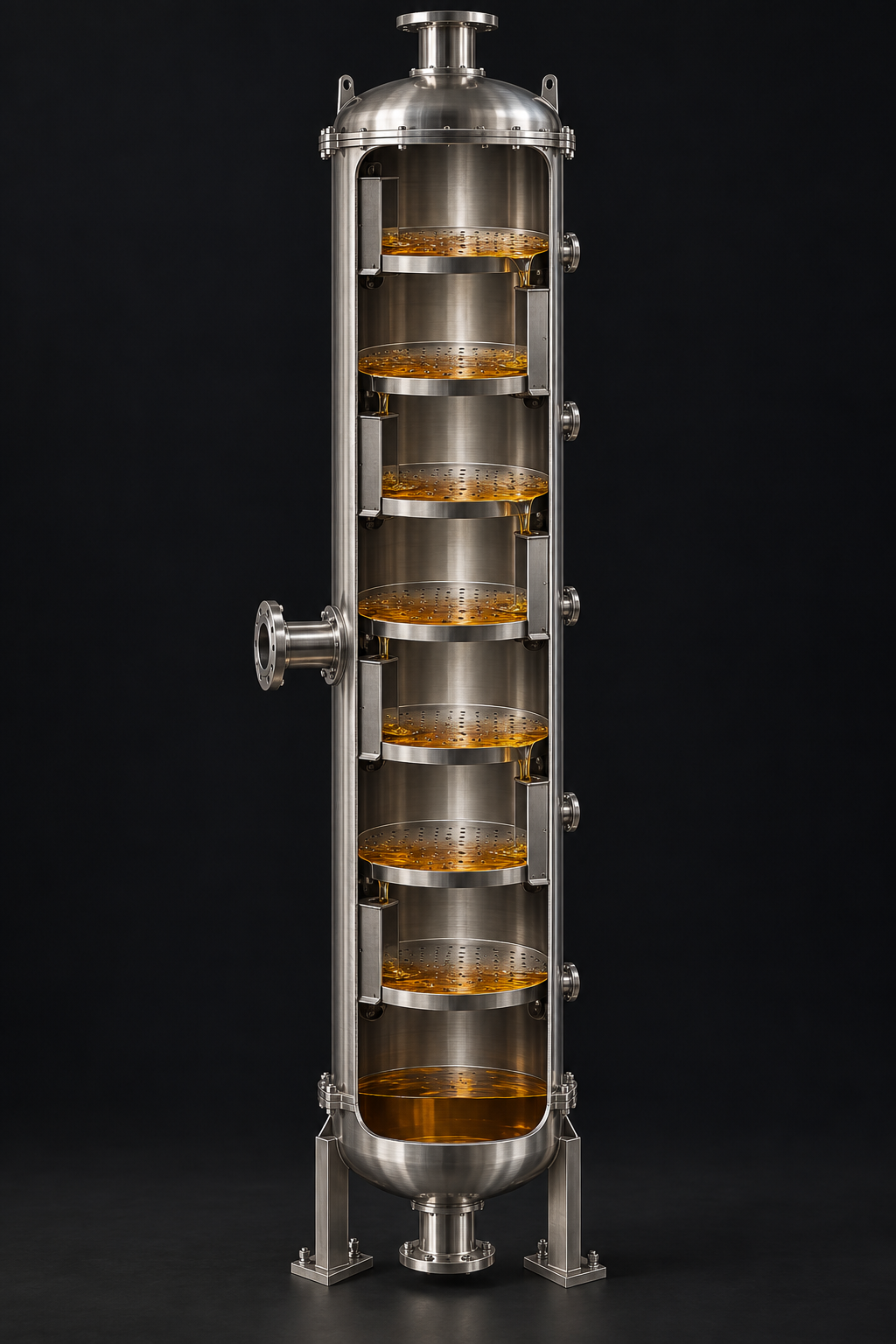 METHOD | Choose a property model you can defend
A visual property-method decision tree, an interactive azeotrope plot, and a checklist for checking the assumptions behind your simulated column.
METHOD | Choose a property model you can defend
A visual property-method decision tree, an interactive azeotrope plot, and a checklist for checking the assumptions behind your simulated column.
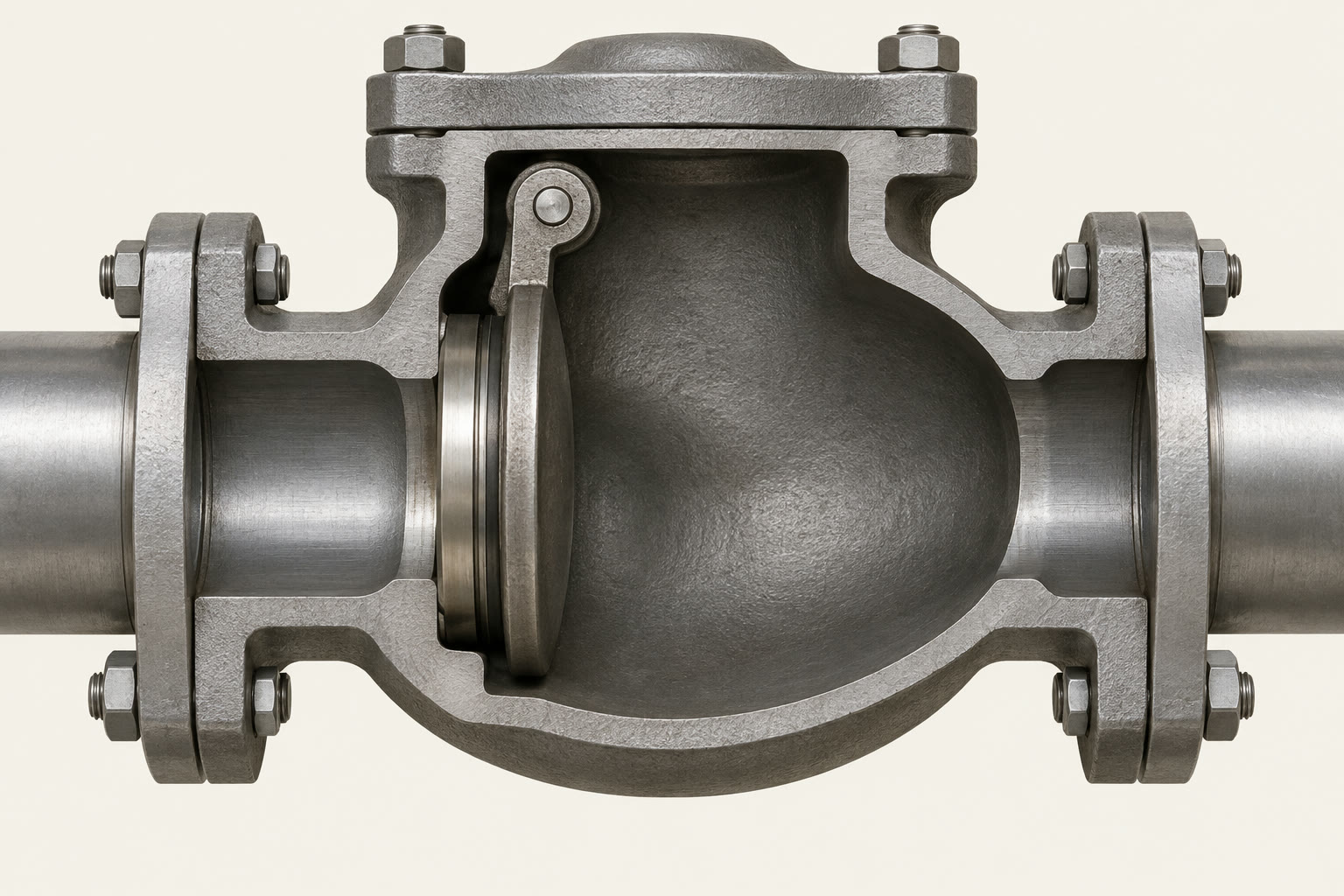 Parallel pumps: two pumps, not twice the flow
Two pumps do not automatically double the flow. Explore the system-curve slider, the shutoff-head check-valve failure and the CHE480 40 bar pump comparison.
Parallel pumps: two pumps, not twice the flow
Two pumps do not automatically double the flow. Explore the system-curve slider, the shutoff-head check-valve failure and the CHE480 40 bar pump comparison.
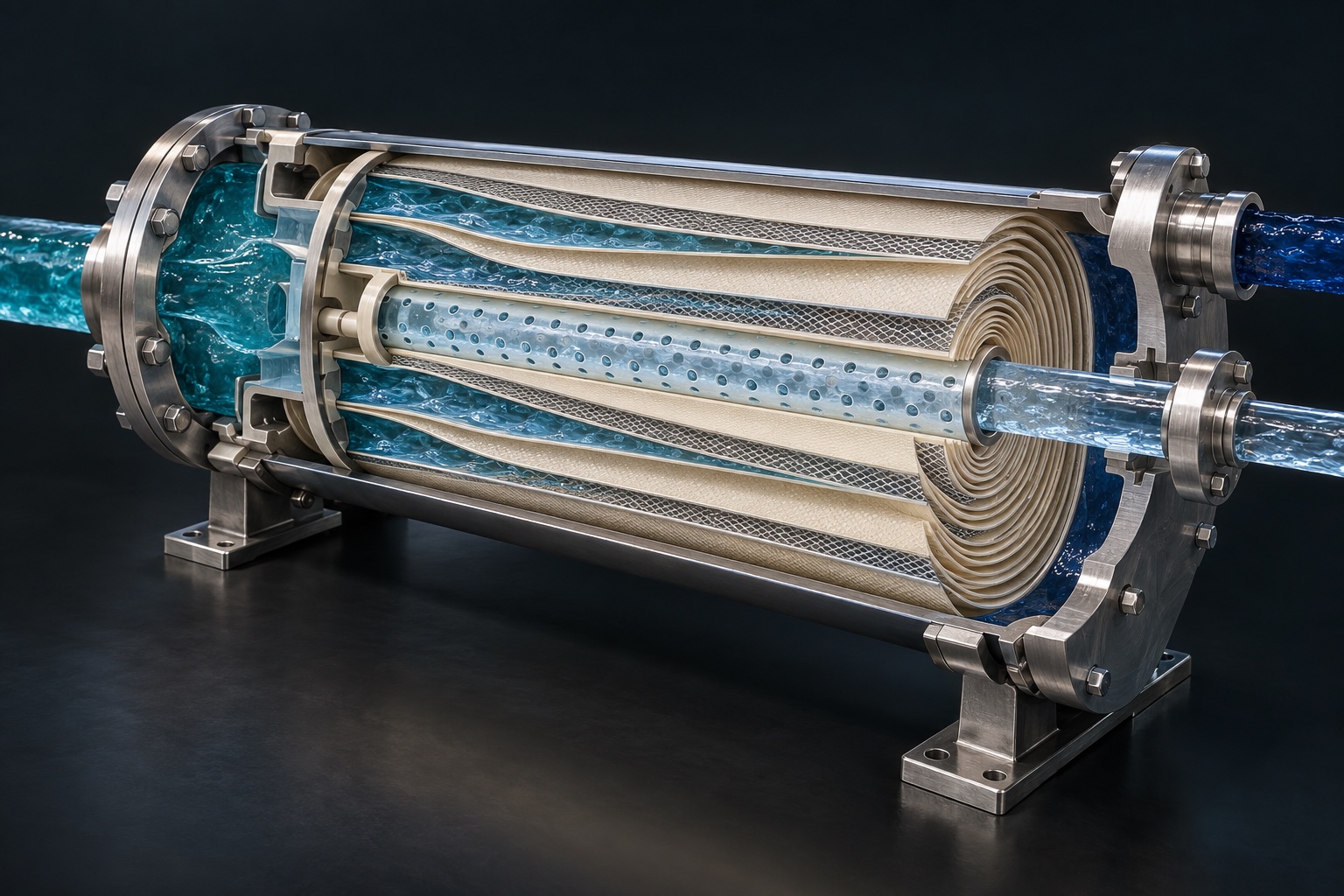 Desalination is one pressure balance
Move the recovery slider and see seawater become brine, osmotic pressure climb, and a pressure exchanger return energy to the feed. The SALT pressure ladder, worksheet and Reflux trial.
Desalination is one pressure balance
Move the recovery slider and see seawater become brine, osmotic pressure climb, and a pressure exchanger return energy to the feed. The SALT pressure ladder, worksheet and Reflux trial.
 Octane: premium is harder to burn, not stronger
Premium gasoline has no more energy in it than regular. The octane number is a score for how well a fuel resists lighting itself before the flame front arrives. This page takes the pump sticker apart into the two lab tests it averages, gives you the four refinery streams with a slider so you can try to hit 87 yourself, and asks the one question that decides whether premium is worth it for your car.
Octane: premium is harder to burn, not stronger
Premium gasoline has no more energy in it than regular. The octane number is a score for how well a fuel resists lighting itself before the flame front arrives. This page takes the pump sticker apart into the two lab tests it averages, gives you the four refinery streams with a slider so you can try to hit 87 yourself, and asks the one question that decides whether premium is worth it for your car.
 Why corn syrup is in everything: one enzyme in a steel column
Corn starch becomes glucose, glucose is not sweet enough, so a corn plant pours it through a packed column of beads with an enzyme locked inside until the mix sits near 42 percent fructose. This page has the enzyme drawn as slots with a slider that lets you add sugar or add enzyme and watch which one actually moves the speed, the bead the sugar cannot diffuse into, and the decay clock that makes the plant turn its pumps down week after week.
Why corn syrup is in everything: one enzyme in a steel column
Corn starch becomes glucose, glucose is not sweet enough, so a corn plant pours it through a packed column of beads with an enzyme locked inside until the mix sits near 42 percent fructose. This page has the enzyme drawn as slots with a slider that lets you add sugar or add enzyme and watch which one actually moves the speed, the bead the sugar cannot diffuse into, and the decay clock that makes the plant turn its pumps down week after week.
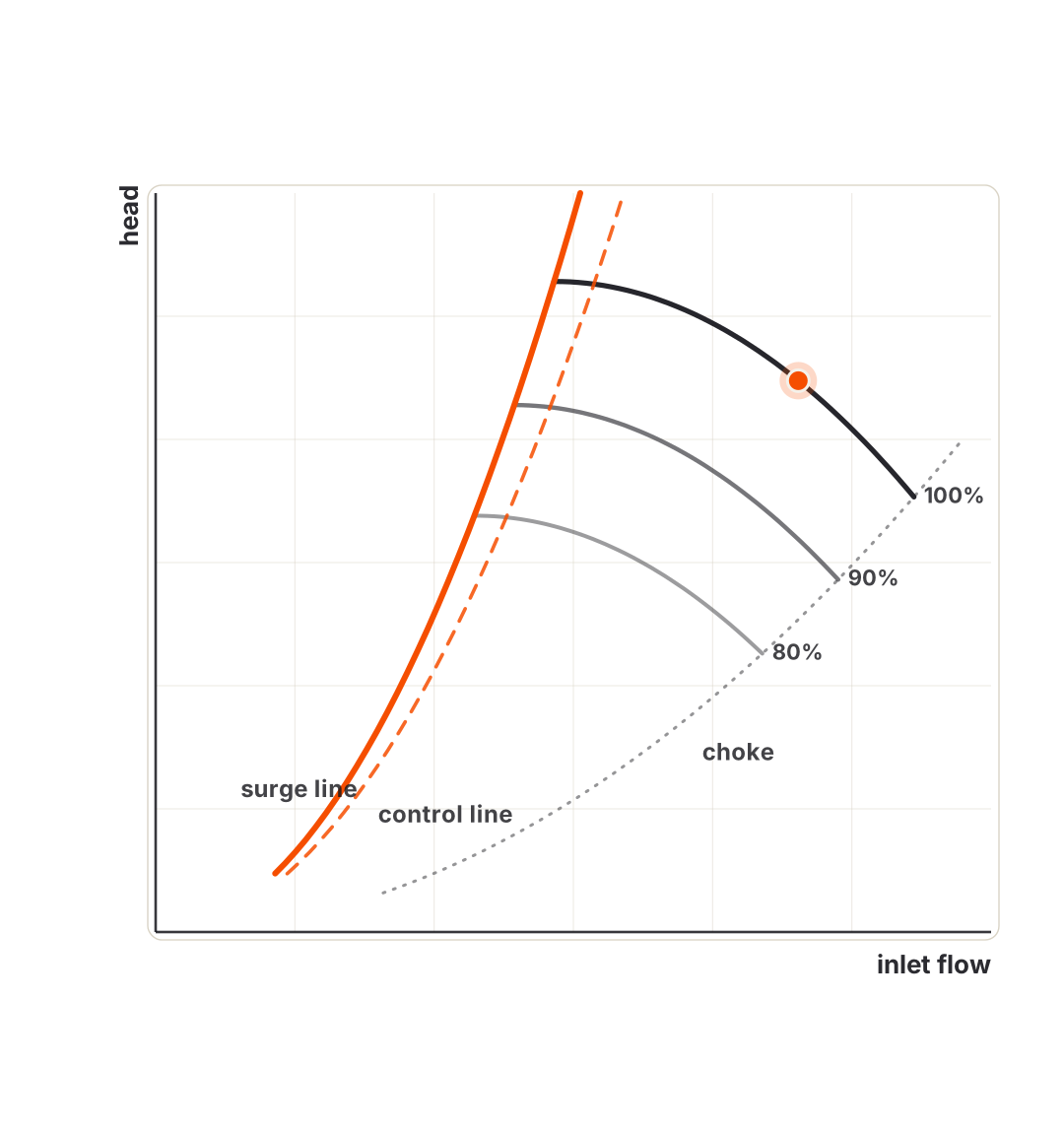 The line a compressor never crosses
A centrifugal compressor can only push gas to a limit. Drop the flow past it and the gas stalls, rushes backwards and the pressure collapses, over and over, flipping the thrust on the shaft every cycle. This page has the map with a valve slider so you can drive the operating point into the surge line yourself, the recycle loop with its two second clock, and the one comparison to add to any steady state model so it turns red when it should.
The line a compressor never crosses
A centrifugal compressor can only push gas to a limit. Drop the flow past it and the gas stalls, rushes backwards and the pressure collapses, over and over, flipping the thrust on the shaft every cycle. This page has the map with a valve slider so you can drive the operating point into the surge line yourself, the recycle loop with its two second clock, and the one comparison to add to any steady state model so it turns red when it should.
 Gold cyanide leaching: the gold is in the water
Gold ore is a few grams in a tonne, so a mine does not pick the gold out, it dissolves it. This page has the leach tank with a grade slider that turns grams per tonne into kilos of dissolved gold, the carbon loading curve that says why a plant loads a quarter of what the textbook promises, and the pH loop that keeps the plant from making hydrogen cyanide gas.
Gold cyanide leaching: the gold is in the water
Gold ore is a few grams in a tonne, so a mine does not pick the gold out, it dissolves it. This page has the leach tank with a grade slider that turns grams per tonne into kilos of dissolved gold, the carbon loading curve that says why a plant loads a quarter of what the textbook promises, and the pH loop that keeps the plant from making hydrogen cyanide gas.
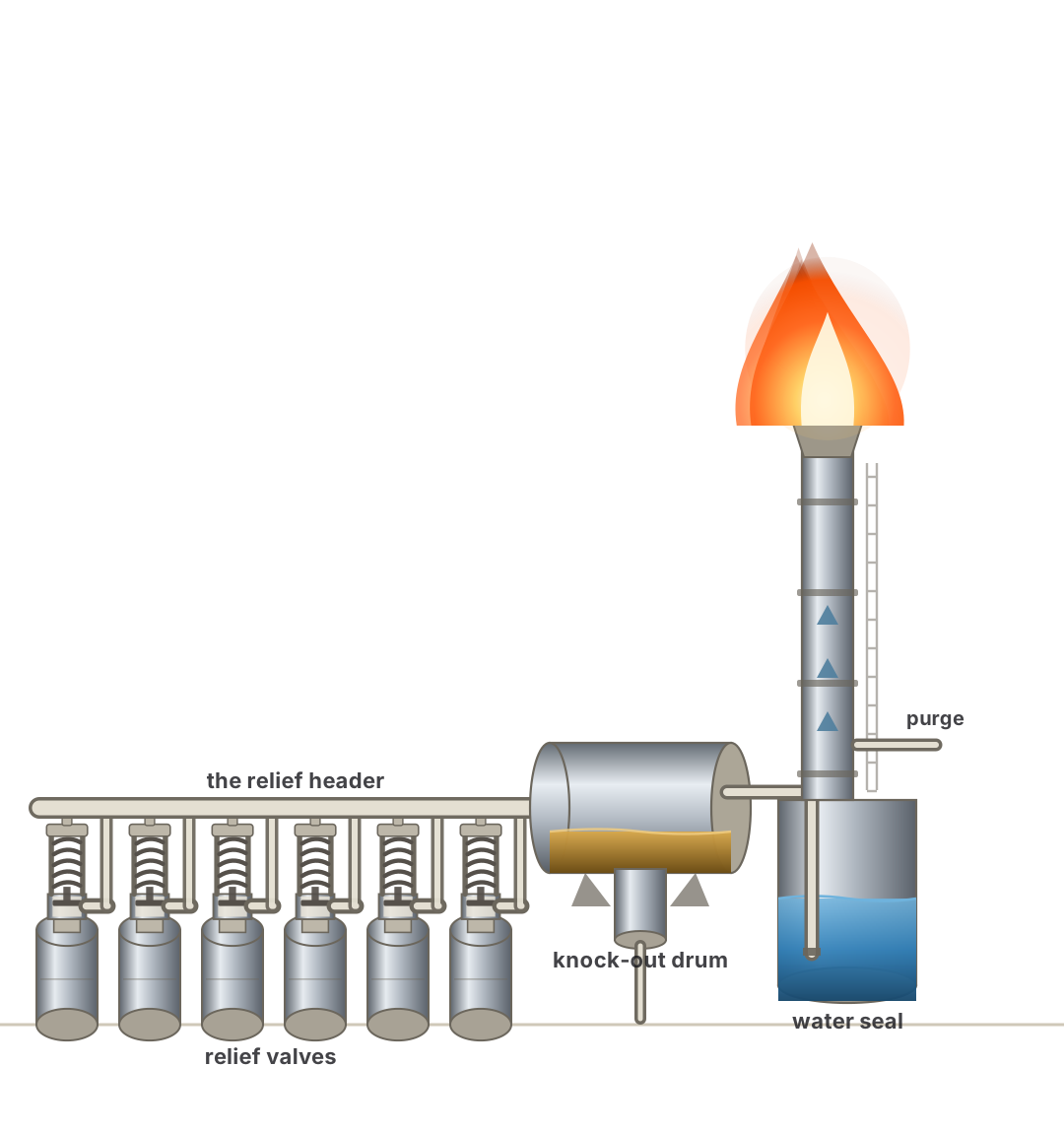 The fire that means the plant is safe
Every relief valve in a plant opens into one pipe. This page draws that pipe end to end, from the valves through the knock-out drum and the water seal to the pilots on the tip, has a calculator where you type the relief load and get the flame length, the radiation radius and the stack height it takes to keep people safe at grade, and the three rules a flare has to keep every hour of its life.
The fire that means the plant is safe
Every relief valve in a plant opens into one pipe. This page draws that pipe end to end, from the valves through the knock-out drum and the water seal to the pilots on the tip, has a calculator where you type the relief load and get the flame length, the radiation radius and the stack height it takes to keep people safe at grade, and the three rules a flare has to keep every hour of its life.
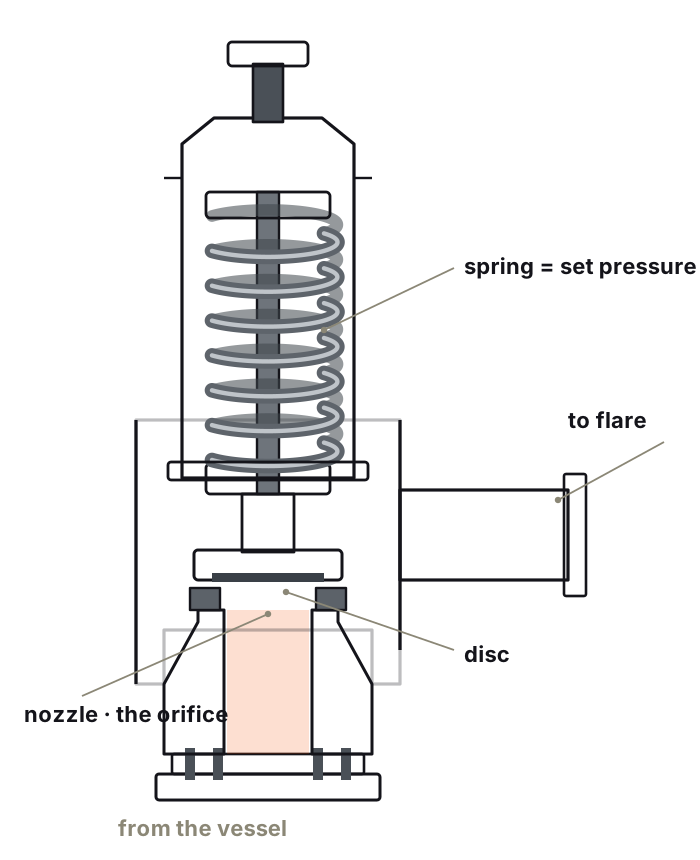 Name the case that sized your relief valve
A relief valve is sized for the single worst believable cause, never the sum of them. This page has the scenario list as a checklist you can run on any vessel, a fire-case calculator where you type the wetted area and get the kilograms an hour and the API 526 orifice, and the minute-by-minute of the 2013 reboiler whose relief valve was the right size and was not connected.
Name the case that sized your relief valve
A relief valve is sized for the single worst believable cause, never the sum of them. This page has the scenario list as a checklist you can run on any vessel, a fire-case calculator where you type the wetted area and get the kilograms an hour and the API 526 orifice, and the minute-by-minute of the 2013 reboiler whose relief valve was the right size and was not connected.
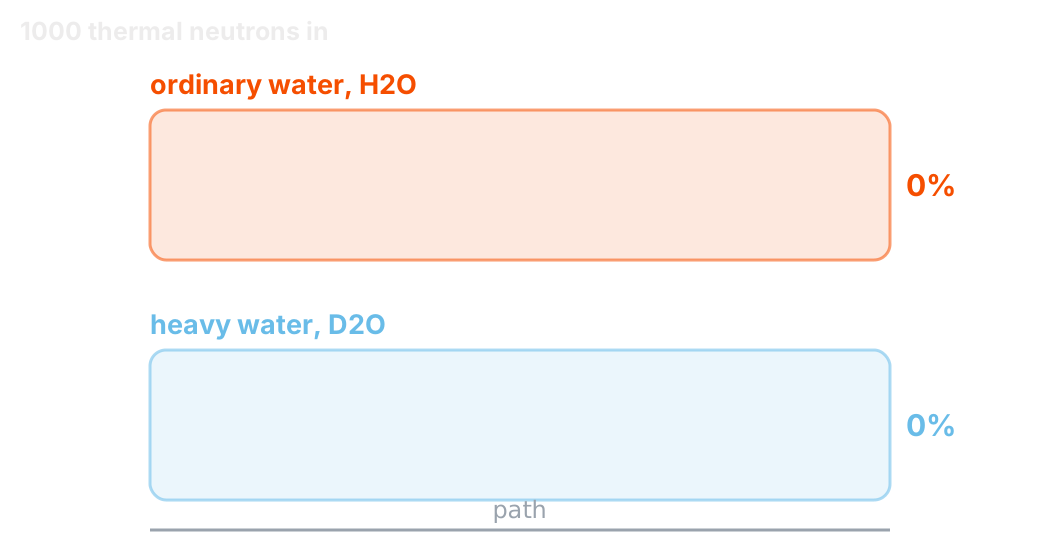 The reactor that runs on rock
Canada's reactors run on natural uranium because heavy water swallows 638 times fewer neutrons than ordinary water. This page has the absorption worked out over a path you can drag, the calandria with its fuelling machines running, and the two calculations that run the plant every morning.
The reactor that runs on rock
Canada's reactors run on natural uranium because heavy water swallows 638 times fewer neutrons than ordinary water. This page has the absorption worked out over a path you can drag, the calandria with its fuelling machines running, and the two calculations that run the plant every morning.
 Axial flow pumps: the one you start with the valve open
An axial flow pump is a propeller in a pipe: huge flow, almost no lift, and a power curve that is upside down. This page has both curves on one graph with a valve you can close, the specific speed ladder that tells you which pump you actually have, and the one start up rule that follows from it.
Axial flow pumps: the one you start with the valve open
An axial flow pump is a propeller in a pipe: huge flow, almost no lift, and a power curve that is upside down. This page has both curves on one graph with a valve you can close, the specific speed ladder that tells you which pump you actually have, and the one start up rule that follows from it.
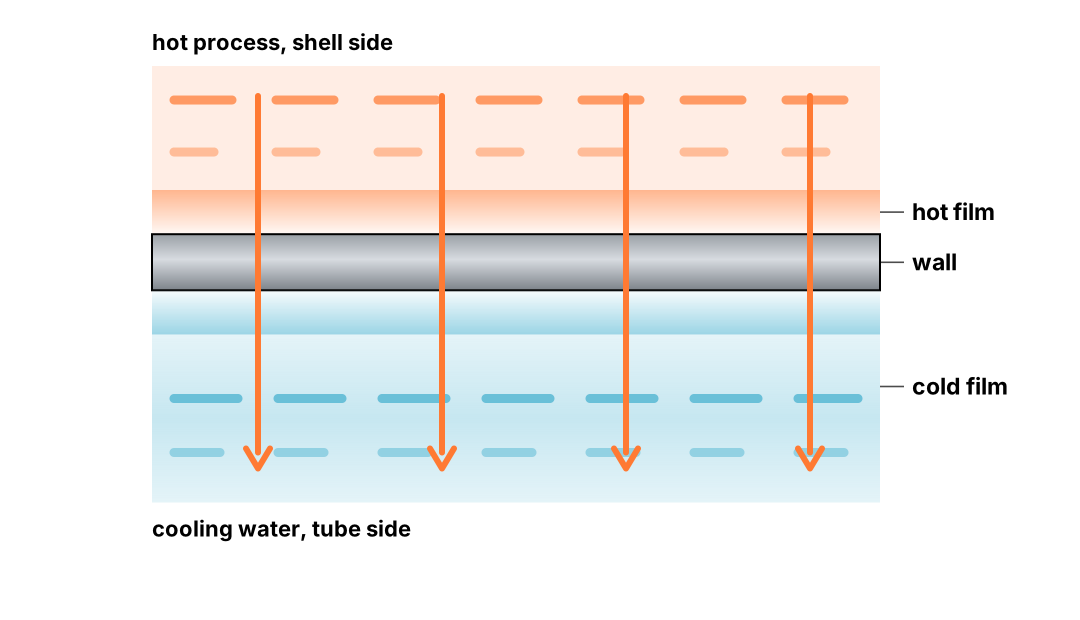 Why the exchanger you oversized fouls faster
A fouling resistance buys area, the area cuts velocity, and the cut velocity is what lays the deposit down. This page has the tube drawn in four layers with a velocity slider you can drag under the threshold and watch the deposit grow, the 1941 table with what it actually is, and the line to design above.
Why the exchanger you oversized fouls faster
A fouling resistance buys area, the area cuts velocity, and the cut velocity is what lays the deposit down. This page has the tube drawn in four layers with a velocity slider you can drag under the threshold and watch the deposit grow, the 1941 table with what it actually is, and the line to design above.
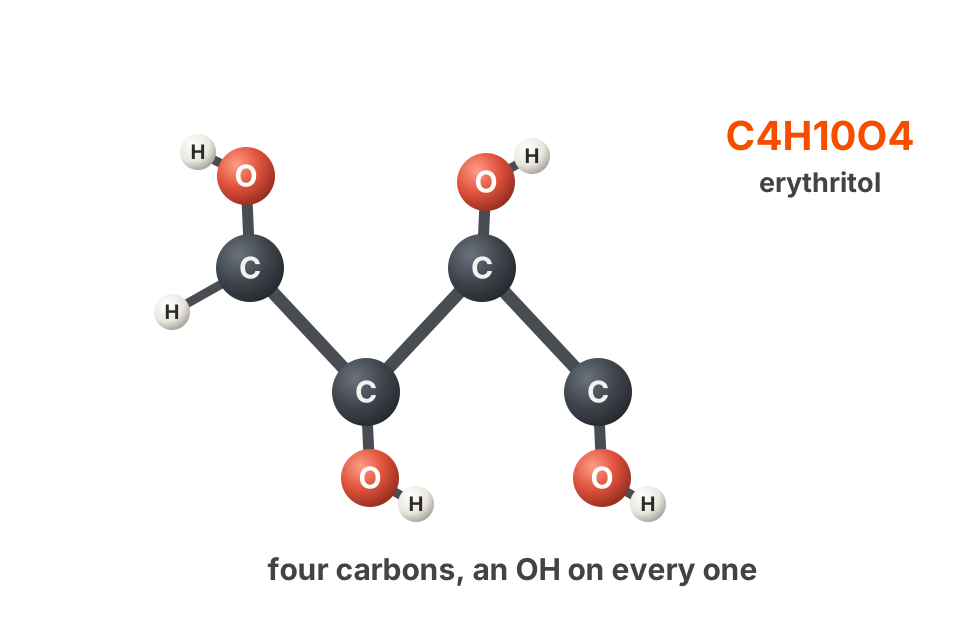 The zero calorie sugar that leaves in your urine
Erythritol is a sugar with its reactive end reduced: about 70 percent as sweet, unburnable by your enzymes and your gut bacteria, and filtered straight back out by your kidneys, about 90 percent in your urine within a day. This page has the path through your body, the fermenter and the crystalliser with a titre slider and the oxygen balance that goes with it, and the 2023 heart study laid out next to what the FDA said about it.
The zero calorie sugar that leaves in your urine
Erythritol is a sugar with its reactive end reduced: about 70 percent as sweet, unburnable by your enzymes and your gut bacteria, and filtered straight back out by your kidneys, about 90 percent in your urine within a day. This page has the path through your body, the fermenter and the crystalliser with a titre slider and the oxygen balance that goes with it, and the 2023 heart study laid out next to what the FDA said about it.
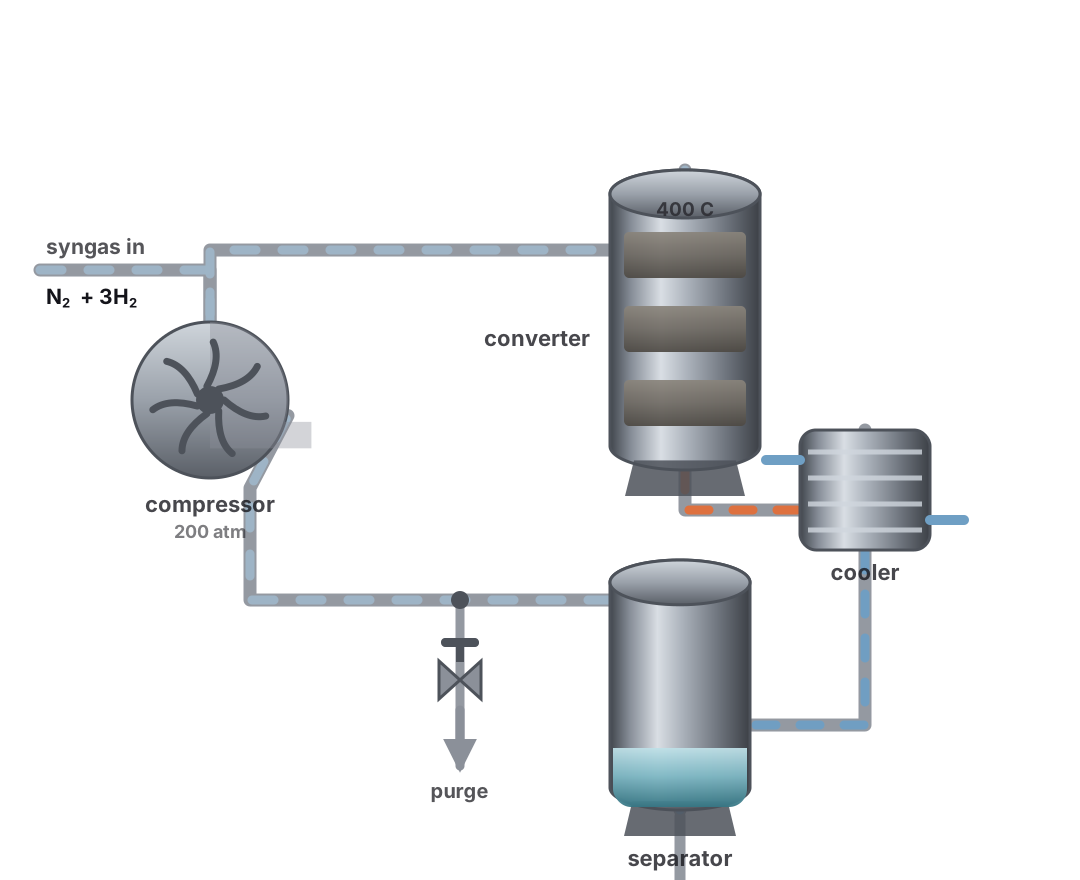 Why 15 percent conversion feeds half the world
Nitrogen is most of the air and plants cannot touch it. Breaking the triple bond takes an iron catalyst, about 400 C and around 200 atmospheres, and even then only about 15 percent reacts per pass. So an ammonia plant is not a reactor, it is a loop. This page has the racetrack with a purge slider that shows the argon piling up as you close it, the steady state balance that sets the number, and why a simulator will not converge this on the first run.
Why 15 percent conversion feeds half the world
Nitrogen is most of the air and plants cannot touch it. Breaking the triple bond takes an iron catalyst, about 400 C and around 200 atmospheres, and even then only about 15 percent reacts per pass. So an ammonia plant is not a reactor, it is a loop. This page has the racetrack with a purge slider that shows the argon piling up as you close it, the steady state balance that sets the number, and why a simulator will not converge this on the first run.
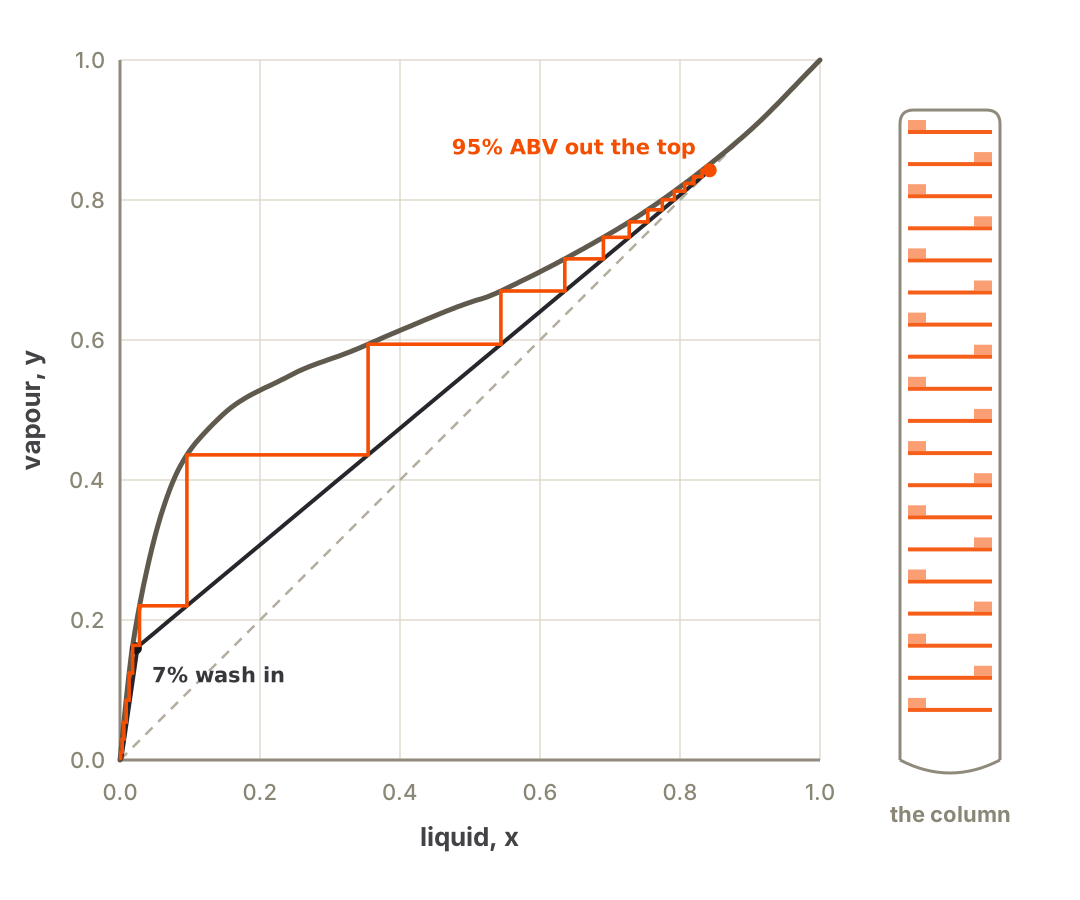 Why the still is a pot and the column is a tower
Why a whisky still is a pot and a refinery column is a tower, and how engineers size both by drawing stairs on a graph. The McCabe Thiele construction on real ethanol and water data, with a reflux slider that redraws the stairs, the step where theoretical stages become real trays, and the two numbers that turn a count into a height.
Why the still is a pot and the column is a tower
Why a whisky still is a pot and a refinery column is a tower, and how engineers size both by drawing stairs on a graph. The McCabe Thiele construction on real ethanol and water data, with a reflux slider that redraws the stairs, the step where theoretical stages become real trays, and the two numbers that turn a count into a height.
 Which way does your fuel valve fail?
A control valve is a spring fighting compressed air. Cut the air and the spring wins, and the end it drives to is set by the actuator, not the valve. Here is the actuator drawn in section with a switch that moves the air to the other side of the diaphragm, the loss-of-signal case nobody draws, the seven minutes a screen read open over a shut valve, and the plant-wide case where every valve fails at once.
Which way does your fuel valve fail?
A control valve is a spring fighting compressed air. Cut the air and the spring wins, and the end it drives to is set by the actuator, not the valve. Here is the actuator drawn in section with a switch that moves the air to the other side of the diaphragm, the loss-of-signal case nobody draws, the seven minutes a screen read open over a shut valve, and the plant-wide case where every valve fails at once.
 Cold is not what kills it
Your phone and cold honey fail for the same reason, and cold is not what kills your battery. A lithium cell is a tiny chemical reactor: ions swim through a liquid, cross a thin skin on the graphite and slot in. Cold thickens the liquid so they crawl, one standard cell held 13 percent at minus 10 C, and it all comes back when it warms. What kills the battery is charging in the cold: ions that cannot slot in plate onto the graphite as lithium metal, for good. Heat grows the skin instead, so ageing is V-shaped. The cell drawn in section, a temperature slider, the V, the pack and its coldest cell.
Cold is not what kills it
Your phone and cold honey fail for the same reason, and cold is not what kills your battery. A lithium cell is a tiny chemical reactor: ions swim through a liquid, cross a thin skin on the graphite and slot in. Cold thickens the liquid so they crawl, one standard cell held 13 percent at minus 10 C, and it all comes back when it warms. What kills the battery is charging in the cold: ions that cannot slot in plate onto the graphite as lithium metal, for good. Heat grows the skin instead, so ageing is V-shaped. The cell drawn in section, a temperature slider, the V, the pack and its coldest cell.
 What an AI driving a simulator actually does
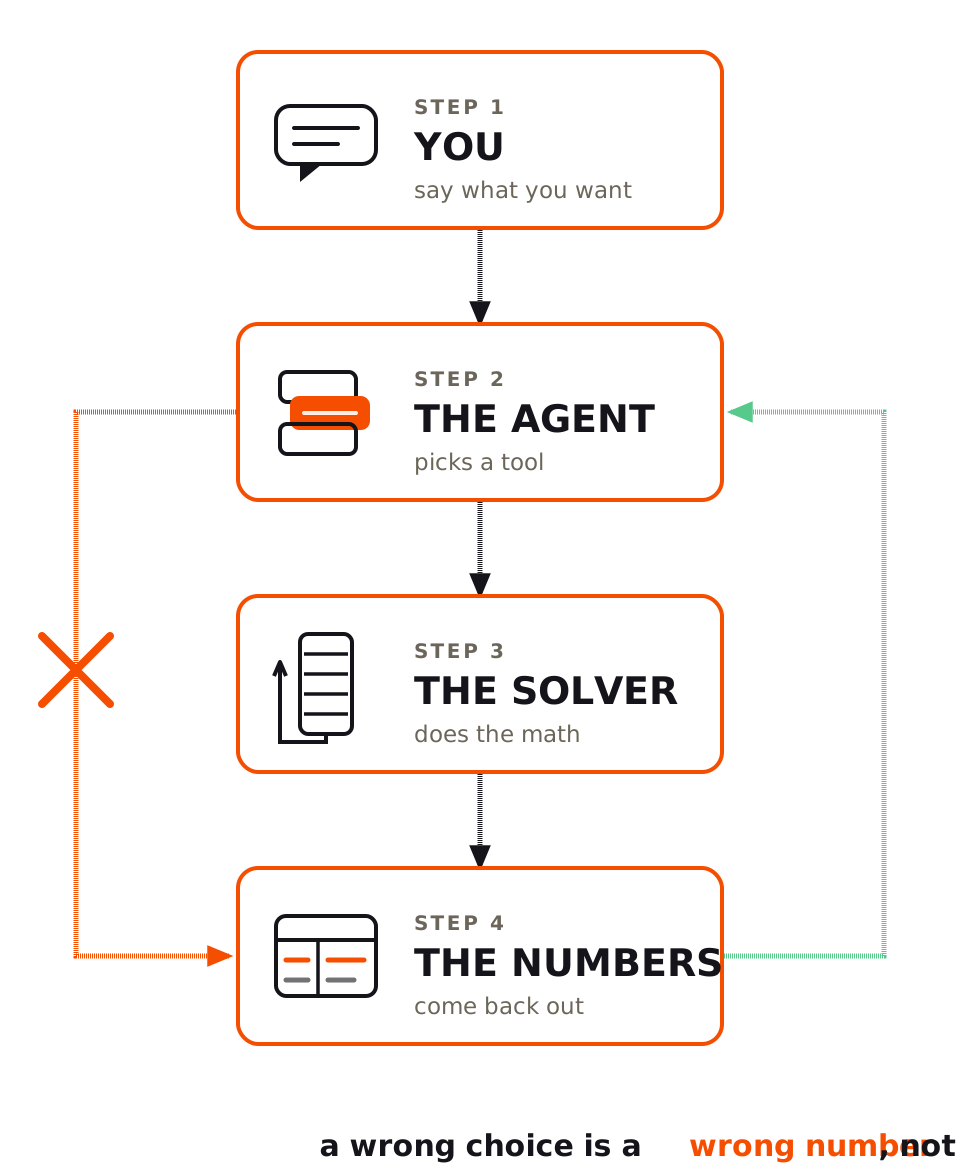
What an AI agent driving a simulator actually does, step by step. You say what you want, the agent picks a tool, the forty-year-old solver you already trust does the math, the agent reads the numbers back and decides what to do next. The model chooses, the solver computes, so a wrong choice gives you a wrong number and not an invented one. Plus the sentence COMSOL and MathWorks both used this year, and a worked stabiliser case you can move yourself.
What an AI driving a simulator actually does
What an AI agent driving a simulator actually does, step by step. You say what you want, the agent picks a tool, the forty-year-old solver you already trust does the math, the agent reads the numbers back and decides what to do next. The model chooses, the solver computes, so a wrong choice gives you a wrong number and not an invented one. Plus the sentence COMSOL and MathWorks both used this year, and a worked stabiliser case you can move yourself.
 Why a paper mill smells like that
Why a kraft pulp mill smells the way it does. The cook dissolves lignin with caustic soda and sodium sulfide, and the sulfide makes four sulfur gases; your nose catches one of them at 70 parts per trillion. The sharp note is the bleach plant and its chlorine dioxide. And the mill recovers 96 to 98 percent of its cooking chemical around a loop, so the smell is the few percent that gets away.
Why a paper mill smells like that
Why a kraft pulp mill smells the way it does. The cook dissolves lignin with caustic soda and sodium sulfide, and the sulfide makes four sulfur gases; your nose catches one of them at 70 parts per trillion. The sharp note is the bleach plant and its chlorine dioxide. And the mill recovers 96 to 98 percent of its cooking chemical around a loop, so the smell is the few percent that gets away.
 The run that converged and was wrong
Aspen Plus writes one line when it has no binary parameters: BINARY PARAMETERS FOR ALL COMPONENT PAIRS ARE ZERO, YOUR RESULTS MAY NOT BE ACCURATE. Then it runs and converges. Zero means ideal: no azeotropes, no liquid split. Here is the exact warning to search your log for, the two columns drawn to scale, the Fenske arithmetic you can do yourself, and the one checkbox that fixes most of it.
The run that converged and was wrong
Aspen Plus writes one line when it has no binary parameters: BINARY PARAMETERS FOR ALL COMPONENT PAIRS ARE ZERO, YOUR RESULTS MAY NOT BE ACCURATE. Then it runs and converges. Zero means ideal: no azeotropes, no liquid split. Here is the exact warning to search your log for, the two columns drawn to scale, the Fenske arithmetic you can do yourself, and the one checkbox that fixes most of it.
 Pipe Sizing: Two Numbers and a Constant Nobody Can Derive
The two numbers that size every line in a plant: about 1 psi of pressure drop per 100 feet of liquid line and about 20 m/s for gas. Why both are ceilings, what happens above and below them, the velocity bands for liquids, gases and steam in one table, and the story of the API RP 14E erosion constant of 100 that came from a wartime Navy figure of 160 and whose theoretical basis a 2019 review calls unclear.
Pipe Sizing: Two Numbers and a Constant Nobody Can Derive
The two numbers that size every line in a plant: about 1 psi of pressure drop per 100 feet of liquid line and about 20 m/s for gas. Why both are ceilings, what happens above and below them, the velocity bands for liquids, gases and steam in one table, and the story of the API RP 14E erosion constant of 100 that came from a wartime Navy figure of 160 and whose theoretical basis a 2019 review calls unclear.
 What a control loop actually does
, with one tank. A level never settles on its own: a sensor reads it, a controller compares it to the setpoint, a valve moves. P is the error now, I is the error added up, D is where it is heading. Tune one yourself, and see the survey of 26,000 real loops where only one in three was doing its job.
What a control loop actually does
What a control loop actually does, with one tank. A level never settles on its own: a sensor reads it, a controller compares it to the setpoint, a valve moves. P is the error now, I is the error added up, D is where it is heading. Tune one yourself, and see the survey of 26,000 real loops where only one in three was doing its job.
 The three drawings a plant is before it exists
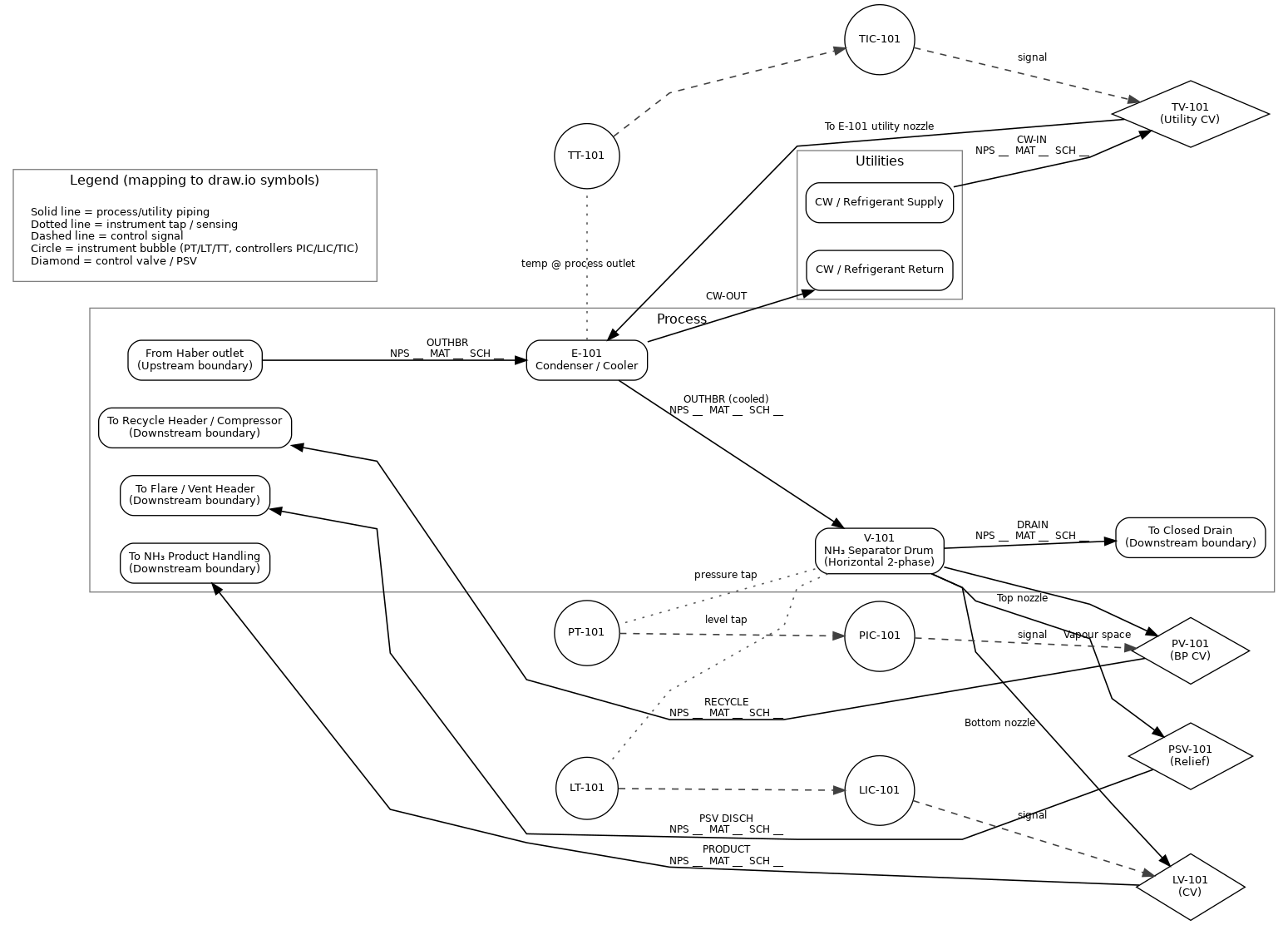
The three drawings a chemical plant is before it exists: the block flow diagram, the process flow diagram and the P&ID. The same pump drawn all three ways, the tag rule that lets you read any sheet, and the two numbers that size every pipe.
The three drawings a plant is before it exists
The three drawings a chemical plant is before it exists: the block flow diagram, the process flow diagram and the P&ID. The same pump drawn all three ways, the tag rule that lets you read any sheet, and the two numbers that size every pipe.
 A Chemist's Number Becomes a Tank
Where a chemist's work ends and a chemical engineer's starts: one number. The rate. Volume equals feed times conversion divided by rate, why a stirred tank has to be bigger than a tube for the same duty, and why 'rate doubles every 10 degrees' is not a law but one activation energy near room temperature.
A Chemist's Number Becomes a Tank
Where a chemist's work ends and a chemical engineer's starts: one number. The rate. Volume equals feed times conversion divided by rate, why a stirred tank has to be bigger than a tube for the same duty, and why 'rate doubles every 10 degrees' is not a law but one activation energy near room temperature.
 Knock-Out Drums: An Empty Can Sized by a Square Root
What a knock-out drum does and why one sits in front of every compressor: gas squeezes and liquid does not, so a slug can wreck a cylinder in one revolution. The Souders-Brown equation worked for three real gases, the mesh pad's real job, the residence-time table for all four vessel types, and the one number that changes when the pressure goes up.
Knock-Out Drums: An Empty Can Sized by a Square Root
What a knock-out drum does and why one sits in front of every compressor: gas squeezes and liquid does not, so a slug can wreck a cylinder in one revolution. The Souders-Brown equation worked for three real gases, the mesh pad's real job, the residence-time table for all four vessel types, and the one number that changes when the pressure goes up.
 The Tank in the Fire
What a BLEVE is and how a propane sphere gets there: why the liquid is a liquid at 8.4 bar, why the steel above the liquid line is the part that fails, what happens when 62.1 degrees of superheat is released at once, the full blast overpressure table, and the three things a design report has to size before a vessel is allowed near a fence.
The Tank in the Fire
What a BLEVE is and how a propane sphere gets there: why the liquid is a liquid at 8.4 bar, why the steel above the liquid line is the part that fails, what happens when 62.1 degrees of superheat is released at once, the full blast overpressure table, and the three things a design report has to size before a vessel is allowed near a fence.
 Why a column is a dial between stages and fuel
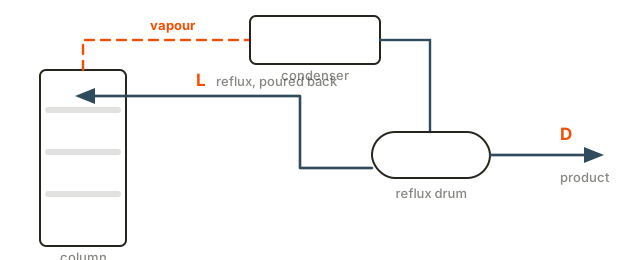
Reflux ratio explained: what R = L / D actually is, why total reflux gives the fewest stages and no product, why minimum reflux needs infinite stages, and what every drop you pour back costs in boil-up. With a live McCabe-Thiele stepper.
Why a column is a dial between stages and fuel
Reflux ratio explained: what R = L / D actually is, why total reflux gives the fewest stages and no product, why minimum reflux needs infinite stages, and what every drop you pour back costs in boil-up. With a live McCabe-Thiele stepper.
 Flood and Weep: How a Column Dies
The three ways a distillation tray fails: jet flood, downcomer flood and weeping. The capacity diagram they make, why every tray is designed to 80% of flood, and how half a metre of tray spacing turns 187 trays into a 94 metre column.
Flood and Weep: How a Column Dies
The three ways a distillation tray fails: jet flood, downcomer flood and weeping. The capacity diagram they make, why every tray is designed to 80% of flood, and how half a metre of tray spacing turns 187 trays into a 94 metre column.
 Why You Cannot Distil Past 96%: The Ethanol Azeotrope
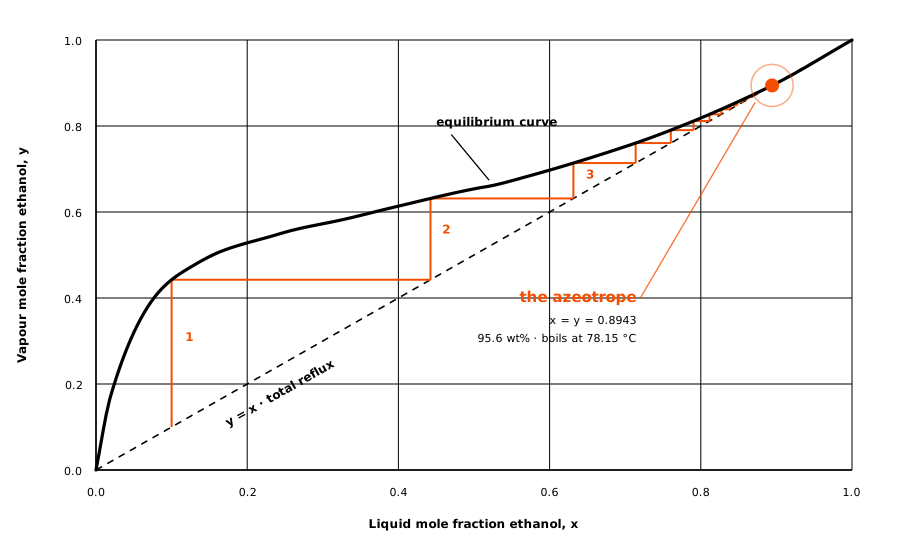
Why no column reaches 100% ethanol: the vapour-liquid equilibrium curve touches the 45-degree line at 0.894 mole fraction, 95.6% by weight, and a stage there buys nothing. The staircase, the relative volatility that decides whether a column is worth building, and the three industrial ways round the azeotrope.
Why You Cannot Distil Past 96%: The Ethanol Azeotrope
Why no column reaches 100% ethanol: the vapour-liquid equilibrium curve touches the 45-degree line at 0.894 mole fraction, 95.6% by weight, and a stage there buys nothing. The staircase, the relative volatility that decides whether a column is worth building, and the three industrial ways round the azeotrope.
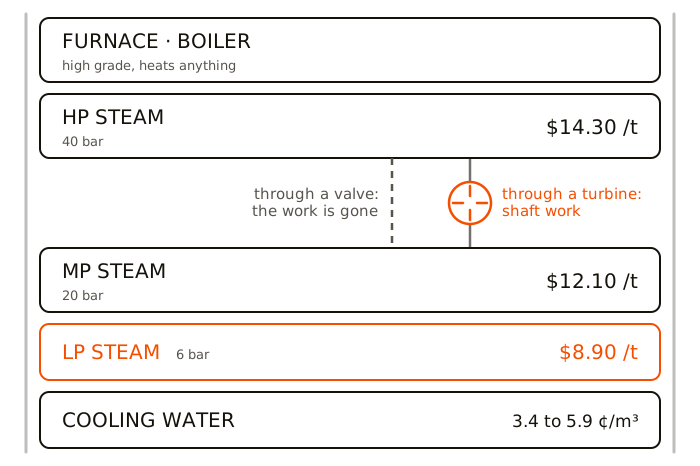 Steam Is Priced By Pressure
The same kilogram of steam costs more at forty bar than at six, and not because it carries more heat. The utility ladder with real Ontario prices on every rung, and the line calculation that turns a heat duty into cents per kilogram of product.
Steam Is Priced By Pressure
The same kilogram of steam costs more at forty bar than at six, and not because it carries more heat. The utility ladder with real Ontario prices on every rung, and the line calculation that turns a heat duty into cents per kilogram of product.
 The Pinch: A Plant That Heats Itself
Pinch analysis in one graph: stack every hot stream into one curve, every cold stream into another, slide them to ΔTmin, and read the minimum steam and cooling water straight off the overhangs. Worked example, the three rules, and why moving heat across the pinch costs you twice.
The Pinch: A Plant That Heats Itself
Pinch analysis in one graph: stack every hot stream into one curve, every cold stream into another, slide them to ΔTmin, and read the minimum steam and cooling water straight off the overhangs. Worked example, the three rules, and why moving heat across the pinch costs you twice.
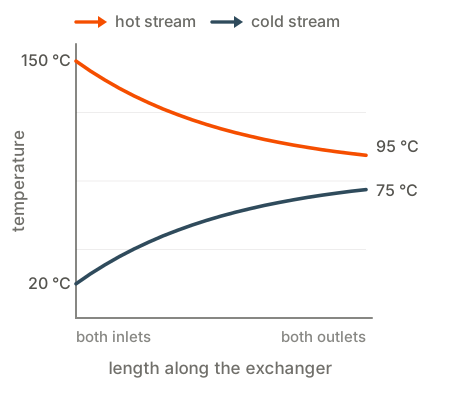 The Flow Direction That Decides How Big Your Exchanger Is
Plumb a heat exchanger co-currently instead of counter-currently and the outlet temperature comes back worse than the arithmetic promised. The ten-second check for a temperature cross, and why the same duty costs more area when both streams run the same way.
The Flow Direction That Decides How Big Your Exchanger Is
Plumb a heat exchanger co-currently instead of counter-currently and the outlet temperature comes back worse than the arithmetic promised. The ten-second check for a temperature cross, and why the same duty costs more area when both streams run the same way.
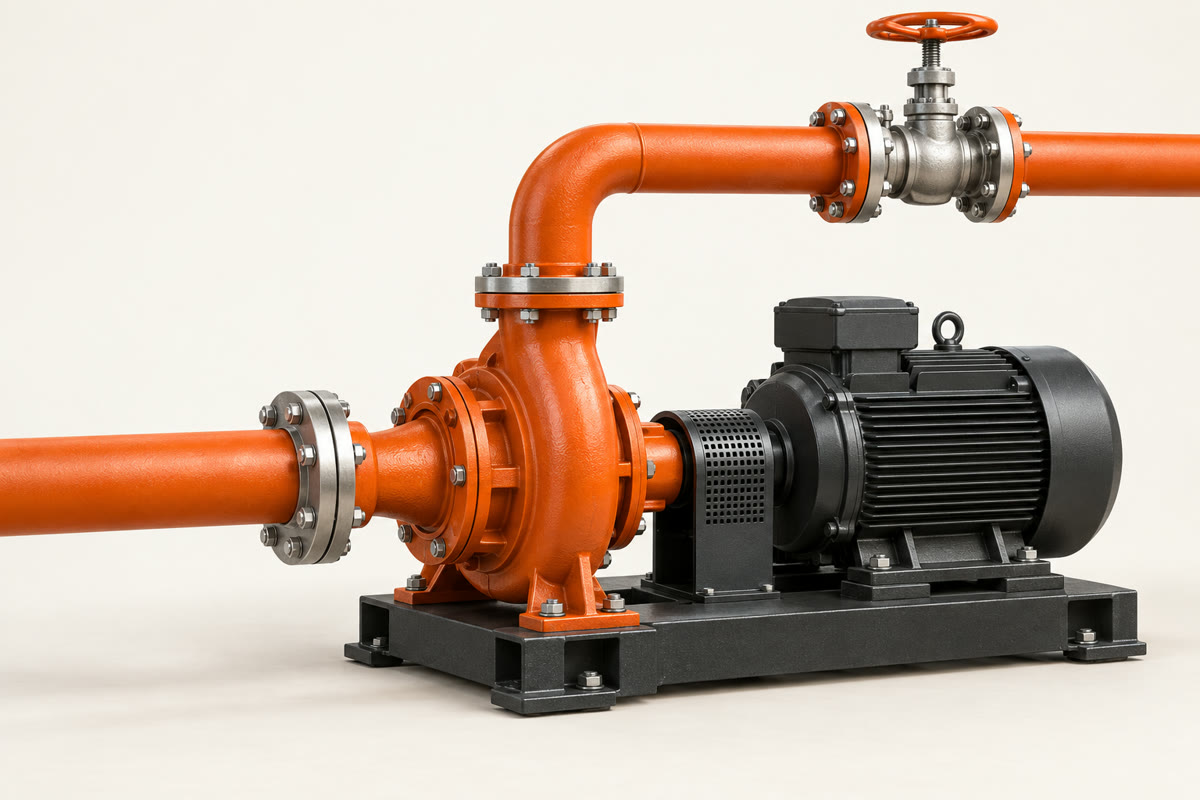 Pump curves, system curves and throttling cost
Explore pump and system curves, move the operating point, and calculate the energy dissipated across a throttling valve. Try Reflux Student free on Aspen Plus.
Pump curves, system curves and throttling cost
Explore pump and system curves, move the operating point, and calculate the energy dissipated across a throttling valve. Try Reflux Student free on Aspen Plus.
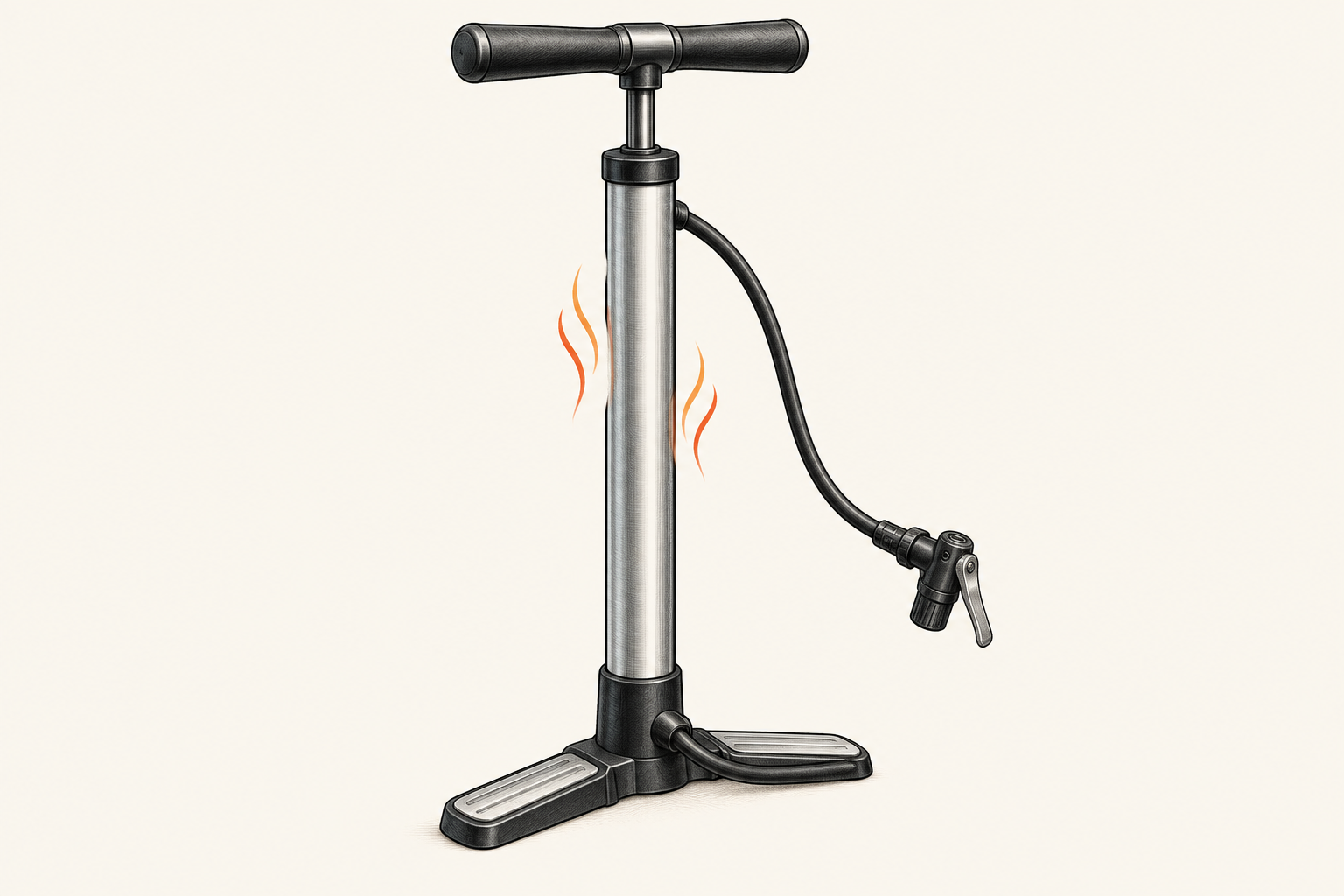 Why compressors need intercooling
Explore compressor stages and intercooling with a temperature calculator, a hydrogen example and the original five-stage P&ID from Reflux Student.
Why compressors need intercooling
Explore compressor stages and intercooling with a temperature calculator, a hydrogen example and the original five-stage P&ID from Reflux Student.
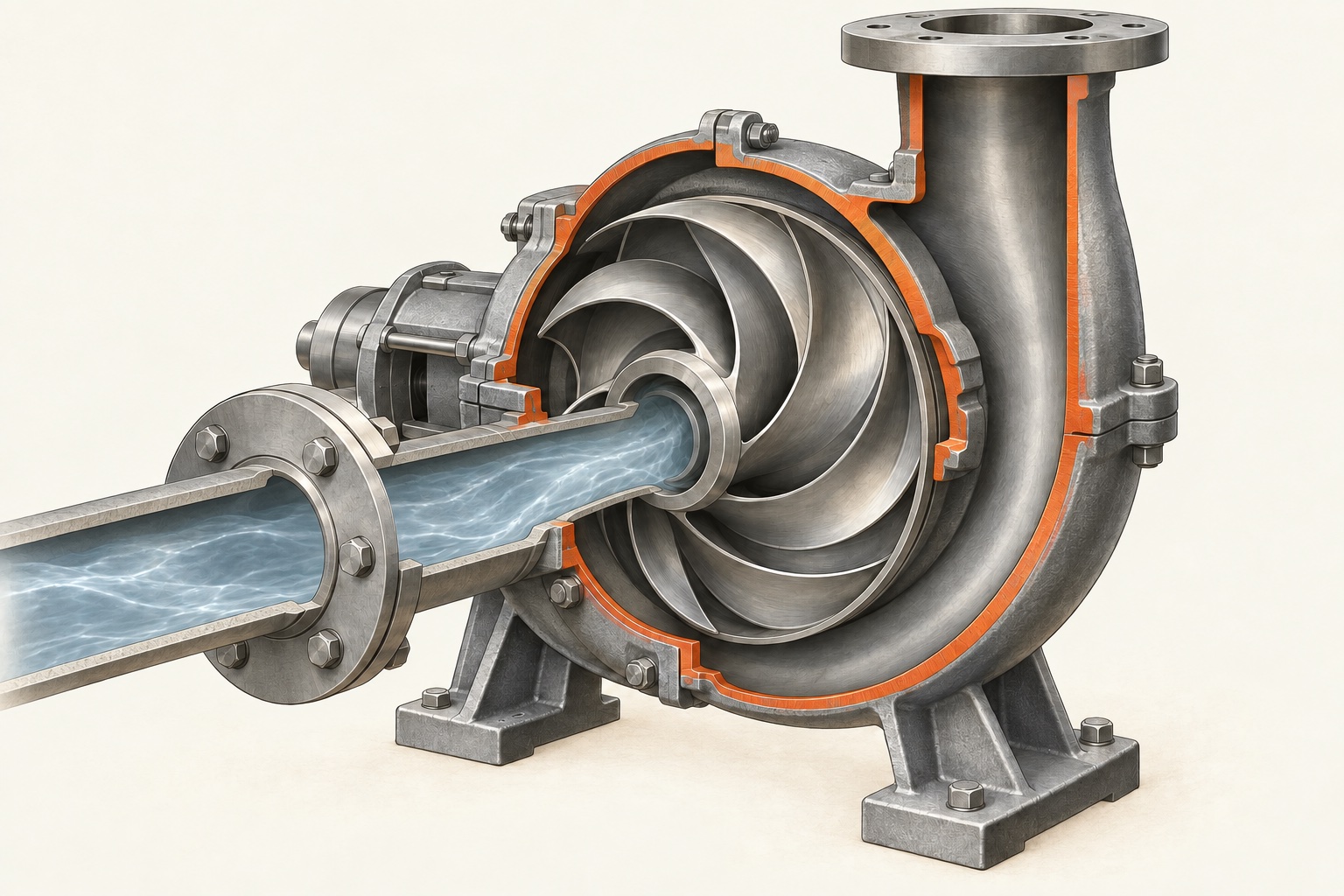 Check the suction side
Why pumps cavitate, what NPSH3 means, and an interactive suction-side NPSH worksheet. Free engineering notes and the free Reflux Student download.
YIELD
Why high yield does not mean low cost
Yield, atom economy and cost per kilogram are different measures. Read the ibuprofen comparison and a worked cost example, and try Reflux Student free on Aspen Plus.
RUNAWAY
Why scale changes heat removal
Why ten times the volume means less than half the cooling per litre. The scale-up calculation, thermal feedback loop, sources, and the free Reflux Student download.
GAP
The Gap Between a Reaction That Works and a Process That Can Be Built
Between a reaction that works in a flask and a process that can be built and sold sits a mountain of work, nearly all of it inside simulation software that takes most of a year to learn. A lot of excellent chemistry never gets assessed at scale because of it.
Check the suction side
Why pumps cavitate, what NPSH3 means, and an interactive suction-side NPSH worksheet. Free engineering notes and the free Reflux Student download.
YIELD
Why high yield does not mean low cost
Yield, atom economy and cost per kilogram are different measures. Read the ibuprofen comparison and a worked cost example, and try Reflux Student free on Aspen Plus.
RUNAWAY
Why scale changes heat removal
Why ten times the volume means less than half the cooling per litre. The scale-up calculation, thermal feedback loop, sources, and the free Reflux Student download.
GAP
The Gap Between a Reaction That Works and a Process That Can Be Built
Between a reaction that works in a flask and a process that can be built and sold sits a mountain of work, nearly all of it inside simulation software that takes most of a year to learn. A lot of excellent chemistry never gets assessed at scale because of it.
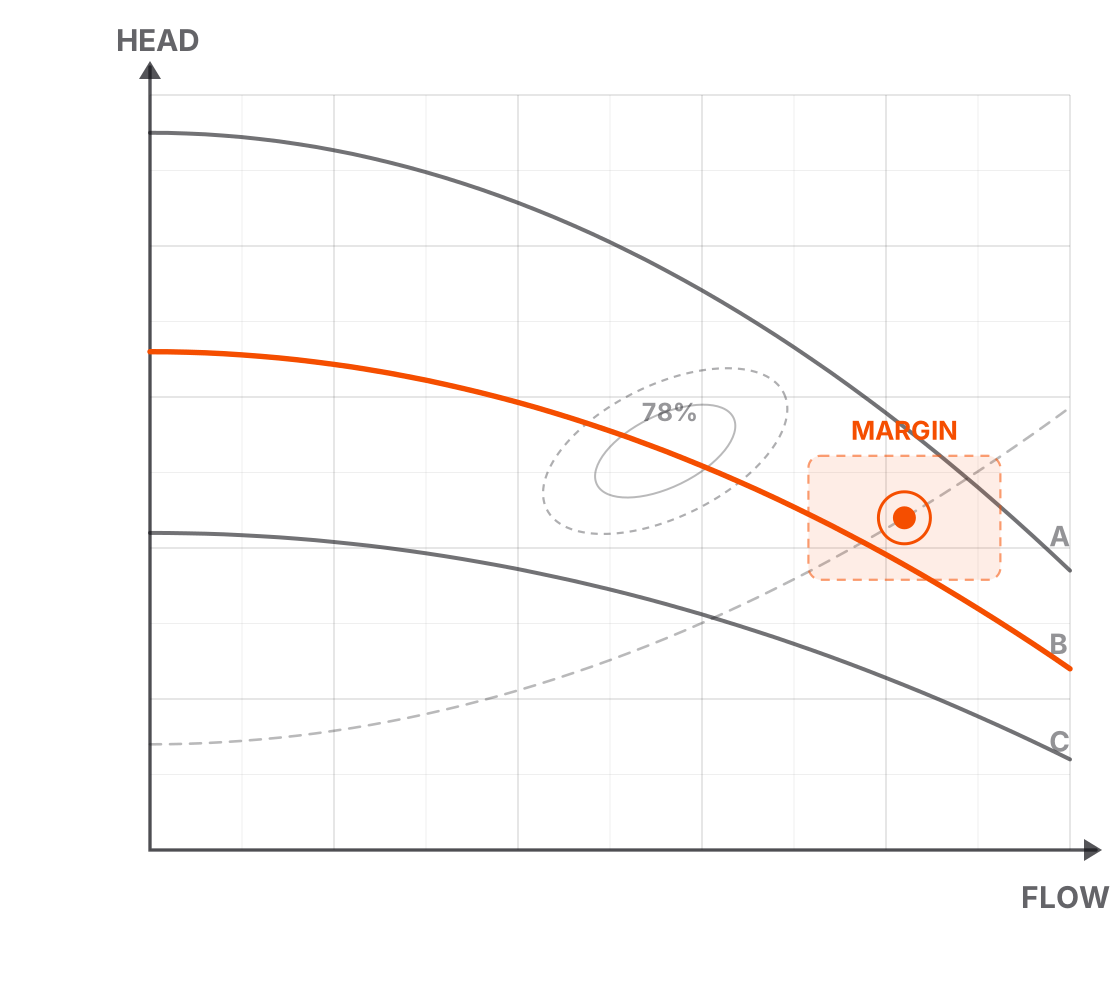 The Pump You Sized Does Not Exist
School has you size an ideal pump and stop. A plant opens a catalogue, finds the curve that covers your duty point with margin, and accepts that it is slightly wrong in every direction. The price is rarely on the page.
The Pump You Sized Does Not Exist
School has you size an ideal pump and stop. A plant opens a catalogue, finds the curve that covers your duty point with margin, and accepts that it is slightly wrong in every direction. The price is rarely on the page.
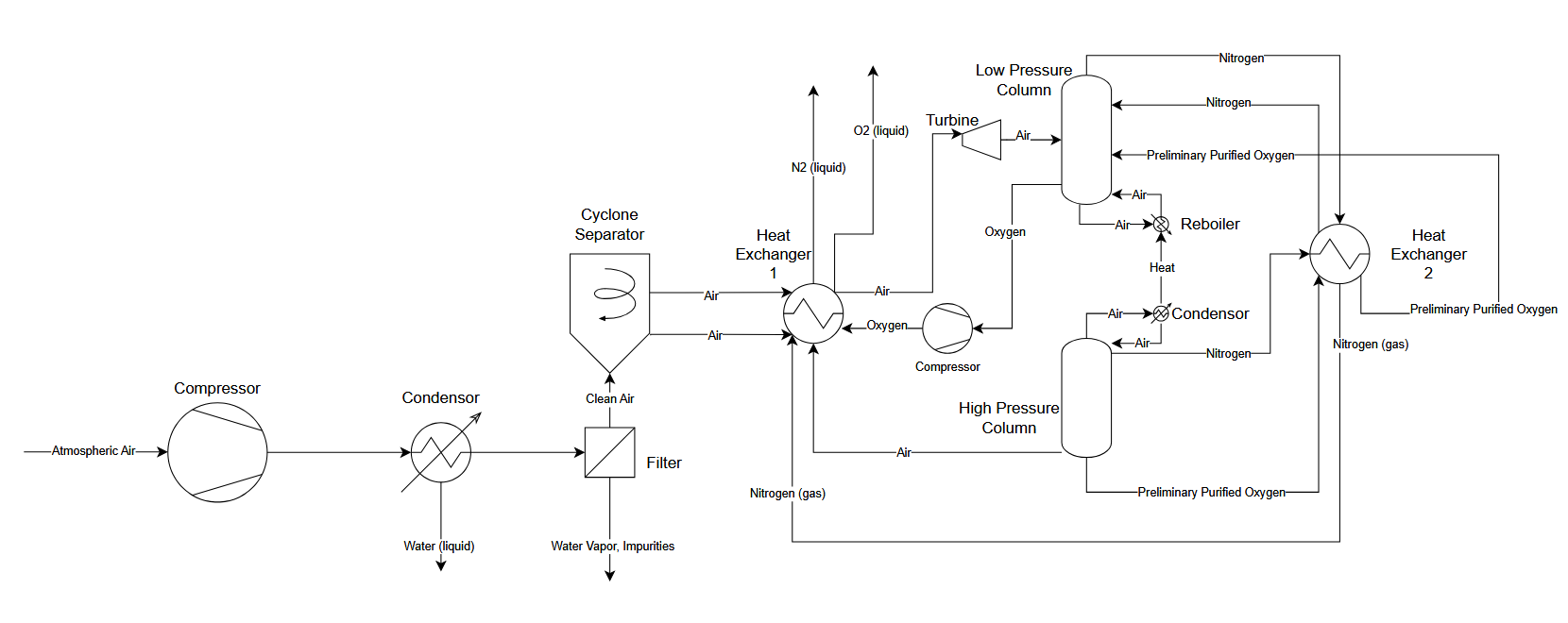 Cement Is 8 Percent of Global Emissions, and the Fuel Is Not the Main Problem
Making clinker cooks limestone into lime, and that reaction releases CO2 no matter what you burn. A fourth-year capstone design that burns the kiln fuel in pure oxygen, purifies the exhaust and puts the carbon back into carbonate rock.
PELLET
The Chemist Ranks the Powder. The Engineer Buys the Cube.
Every absorbent material is ranked as a loose powder and bought as a pressed solid. Pressing costs 10 to 15 percent of the surface area for robust frameworks and up to 43 percent for fragile ones, which is enough to reverse the ranking.
PLANT
Five Things a Chemist Sees on Their First Walk Through a Plant
The mixers move the whole tank, the drums weigh more than a pickup, a plant is twenty floors of pipe, and absorbers and strippers are the same tower shape doing opposite jobs. Five things that shock a chemist on day one inside a plant.
CAPTURE
Why the Solvent Dies and the Model Never Saw It Coming
Flue gas carries oxygen, oxygen attacks the amine, and the heat-stable salts it leaves behind cannot release CO2, corrode steel and raise the energy bill. Published capture models generally do not include any of it.
THREE THINGS
The Three Things Process Engineers Hate About Their Simulation Software
Three hundred discovery calls with process engineers, and everyone hates the same three things about their simulation software: the setup grind, convergence that will not say why, and licensing that belongs in 1998.
Note
What reviewed, verifiable AI automation means in process simulation
Why AI tools that write to a simulator should verify every change by reading it back, and gate every reported result, before an engineer trusts a word.
Note
Can AI drive Aspen Plus? How natural-language control of a process simulator actually works
What programmatic control of Aspen Plus really is, what an AI agent can do with it today, and why write verification and review gates decide whether you can trust it.
Note
AI copilot vs. homegrown scripts for process simulator automation
An honest comparison of Python/VBA COM scripting and an AI copilot for Aspen Plus automation, including when the plain script is still the right tool.
Note
Using an AI copilot to troubleshoot simulation convergence failures
A practical look at how an AI copilot turns convergence troubleshooting from guess-and-rerun into one verified change at a time.
Note
How Reflux came to be
The product intuition behind visible, reviewed simulation workflows.
Note
Visible distillation train
How a reviewed process-study flow can make simulator work easier to inspect.
Note
Template-backed generation
Using known-good cases and templates as the starting point for repeatable runs.
Note
Desktop simulator adapter
How local simulator control becomes a reviewable product surface.
Note
Reviewed plans for process models
Why the review gate is central to agentic process-model automation.
Cement Is 8 Percent of Global Emissions, and the Fuel Is Not the Main Problem
Making clinker cooks limestone into lime, and that reaction releases CO2 no matter what you burn. A fourth-year capstone design that burns the kiln fuel in pure oxygen, purifies the exhaust and puts the carbon back into carbonate rock.
PELLET
The Chemist Ranks the Powder. The Engineer Buys the Cube.
Every absorbent material is ranked as a loose powder and bought as a pressed solid. Pressing costs 10 to 15 percent of the surface area for robust frameworks and up to 43 percent for fragile ones, which is enough to reverse the ranking.
PLANT
Five Things a Chemist Sees on Their First Walk Through a Plant
The mixers move the whole tank, the drums weigh more than a pickup, a plant is twenty floors of pipe, and absorbers and strippers are the same tower shape doing opposite jobs. Five things that shock a chemist on day one inside a plant.
CAPTURE
Why the Solvent Dies and the Model Never Saw It Coming
Flue gas carries oxygen, oxygen attacks the amine, and the heat-stable salts it leaves behind cannot release CO2, corrode steel and raise the energy bill. Published capture models generally do not include any of it.
THREE THINGS
The Three Things Process Engineers Hate About Their Simulation Software
Three hundred discovery calls with process engineers, and everyone hates the same three things about their simulation software: the setup grind, convergence that will not say why, and licensing that belongs in 1998.
Note
What reviewed, verifiable AI automation means in process simulation
Why AI tools that write to a simulator should verify every change by reading it back, and gate every reported result, before an engineer trusts a word.
Note
Can AI drive Aspen Plus? How natural-language control of a process simulator actually works
What programmatic control of Aspen Plus really is, what an AI agent can do with it today, and why write verification and review gates decide whether you can trust it.
Note
AI copilot vs. homegrown scripts for process simulator automation
An honest comparison of Python/VBA COM scripting and an AI copilot for Aspen Plus automation, including when the plain script is still the right tool.
Note
Using an AI copilot to troubleshoot simulation convergence failures
A practical look at how an AI copilot turns convergence troubleshooting from guess-and-rerun into one verified change at a time.
Note
How Reflux came to be
The product intuition behind visible, reviewed simulation workflows.
Note
Visible distillation train
How a reviewed process-study flow can make simulator work easier to inspect.
Note
Template-backed generation
Using known-good cases and templates as the starting point for repeatable runs.
Note
Desktop simulator adapter
How local simulator control becomes a reviewable product surface.
Note
Reviewed plans for process models
Why the review gate is central to agentic process-model automation.
HAMMER | Water hammer explained
Stop 2 m/s of water and add 24 bar. Explore a cutaway pipe, change velocity and length, and see why valve closure time matters.
PILOT — What changes after the lab
Grow a reactor and watch jacket area per litre fall. Explore mixing, solids and the four questions a pilot plant answers, with the original 44-plant study.
DECAY
DECAY | The heat after shutdown
Shutting down the chain reaction does not stop decay heat. Explore a reactor cutaway, a decay-heat curve, and the first-day energy integral.
LEVEL | A drum buys you time
Explore the four jobs inside a process drum. Change flow and holdup time, watch the level move, and learn why independent overfill protection matters.
Why here? The engineering of plant siting
Why chemical plants cluster beside rivers and ports. Explore feed, cooling and separation, then turn heat duty into cooling-water flow.
Why fermentation tanks need cooling
Grow a beer fermentation tank from 10 to 1,000 hL. Explore jacket cooling, the batch energy balance, temperature and flavour, and the CO2 count. A dedicated BREW worksheet and Reflux waitlist.
METHOD | Choose a property model you can defend
A visual property-method decision tree, an interactive azeotrope plot, and a checklist for checking the assumptions behind your simulated column.
Parallel pumps: two pumps, not twice the flow
Two pumps do not automatically double the flow. Explore the system-curve slider, the shutoff-head check-valve failure and the CHE480 40 bar pump comparison.
Desalination is one pressure balance
Move the recovery slider and see seawater become brine, osmotic pressure climb, and a pressure exchanger return energy to the feed. The SALT pressure ladder, worksheet and Reflux trial.
Octane: premium is harder to burn, not stronger
Premium gasoline has no more energy in it than regular. The octane number is a score for how well a fuel resists lighting itself before the flame front arrives. This page takes the pump sticker apart into the two lab tests it averages, gives you the four refinery streams with a slider so you can try to hit 87 yourself, and asks the one question that decides whether premium is worth it for your car.
Why corn syrup is in everything: one enzyme in a steel column
Corn starch becomes glucose, glucose is not sweet enough, so a corn plant pours it through a packed column of beads with an enzyme locked inside until the mix sits near 42 percent fructose. This page has the enzyme drawn as slots with a slider that lets you add sugar or add enzyme and watch which one actually moves the speed, the bead the sugar cannot diffuse into, and the decay clock that makes the plant turn its pumps down week after week.
The line a compressor never crosses
A centrifugal compressor can only push gas to a limit. Drop the flow past it and the gas stalls, rushes backwards and the pressure collapses, over and over, flipping the thrust on the shaft every cycle. This page has the map with a valve slider so you can drive the operating point into the surge line yourself, the recycle loop with its two second clock, and the one comparison to add to any steady state model so it turns red when it should.
Gold cyanide leaching: the gold is in the water
Gold ore is a few grams in a tonne, so a mine does not pick the gold out, it dissolves it. This page has the leach tank with a grade slider that turns grams per tonne into kilos of dissolved gold, the carbon loading curve that says why a plant loads a quarter of what the textbook promises, and the pH loop that keeps the plant from making hydrogen cyanide gas.
The fire that means the plant is safe
Every relief valve in a plant opens into one pipe. This page draws that pipe end to end, from the valves through the knock-out drum and the water seal to the pilots on the tip, has a calculator where you type the relief load and get the flame length, the radiation radius and the stack height it takes to keep people safe at grade, and the three rules a flare has to keep every hour of its life.
Name the case that sized your relief valve
A relief valve is sized for the single worst believable cause, never the sum of them. This page has the scenario list as a checklist you can run on any vessel, a fire-case calculator where you type the wetted area and get the kilograms an hour and the API 526 orifice, and the minute-by-minute of the 2013 reboiler whose relief valve was the right size and was not connected.
The reactor that runs on rock
Canada's reactors run on natural uranium because heavy water swallows 638 times fewer neutrons than ordinary water. This page has the absorption worked out over a path you can drag, the calandria with its fuelling machines running, and the two calculations that run the plant every morning.
Axial flow pumps: the one you start with the valve open
An axial flow pump is a propeller in a pipe: huge flow, almost no lift, and a power curve that is upside down. This page has both curves on one graph with a valve you can close, the specific speed ladder that tells you which pump you actually have, and the one start up rule that follows from it.
Why the exchanger you oversized fouls faster
A fouling resistance buys area, the area cuts velocity, and the cut velocity is what lays the deposit down. This page has the tube drawn in four layers with a velocity slider you can drag under the threshold and watch the deposit grow, the 1941 table with what it actually is, and the line to design above.
The zero calorie sugar that leaves in your urine
Erythritol is a sugar with its reactive end reduced: about 70 percent as sweet, unburnable by your enzymes and your gut bacteria, and filtered straight back out by your kidneys, about 90 percent in your urine within a day. This page has the path through your body, the fermenter and the crystalliser with a titre slider and the oxygen balance that goes with it, and the 2023 heart study laid out next to what the FDA said about it.
Why 15 percent conversion feeds half the world
Nitrogen is most of the air and plants cannot touch it. Breaking the triple bond takes an iron catalyst, about 400 C and around 200 atmospheres, and even then only about 15 percent reacts per pass. So an ammonia plant is not a reactor, it is a loop. This page has the racetrack with a purge slider that shows the argon piling up as you close it, the steady state balance that sets the number, and why a simulator will not converge this on the first run.
Why the still is a pot and the column is a tower
Why a whisky still is a pot and a refinery column is a tower, and how engineers size both by drawing stairs on a graph. The McCabe Thiele construction on real ethanol and water data, with a reflux slider that redraws the stairs, the step where theoretical stages become real trays, and the two numbers that turn a count into a height.
Which way does your fuel valve fail?
A control valve is a spring fighting compressed air. Cut the air and the spring wins, and the end it drives to is set by the actuator, not the valve. Here is the actuator drawn in section with a switch that moves the air to the other side of the diaphragm, the loss-of-signal case nobody draws, the seven minutes a screen read open over a shut valve, and the plant-wide case where every valve fails at once.
Cold is not what kills it
Your phone and cold honey fail for the same reason, and cold is not what kills your battery. A lithium cell is a tiny chemical reactor: ions swim through a liquid, cross a thin skin on the graphite and slot in. Cold thickens the liquid so they crawl, one standard cell held 13 percent at minus 10 C, and it all comes back when it warms. What kills the battery is charging in the cold: ions that cannot slot in plate onto the graphite as lithium metal, for good. Heat grows the skin instead, so ageing is V-shaped. The cell drawn in section, a temperature slider, the V, the pack and its coldest cell.
What an AI driving a simulator actually does
What an AI agent driving a simulator actually does, step by step. You say what you want, the agent picks a tool, the forty-year-old solver you already trust does the math, the agent reads the numbers back and decides what to do next. The model chooses, the solver computes, so a wrong choice gives you a wrong number and not an invented one. Plus the sentence COMSOL and MathWorks both used this year, and a worked stabiliser case you can move yourself.
Why a paper mill smells like that
Why a kraft pulp mill smells the way it does. The cook dissolves lignin with caustic soda and sodium sulfide, and the sulfide makes four sulfur gases; your nose catches one of them at 70 parts per trillion. The sharp note is the bleach plant and its chlorine dioxide. And the mill recovers 96 to 98 percent of its cooking chemical around a loop, so the smell is the few percent that gets away.
The run that converged and was wrong
Aspen Plus writes one line when it has no binary parameters: BINARY PARAMETERS FOR ALL COMPONENT PAIRS ARE ZERO, YOUR RESULTS MAY NOT BE ACCURATE. Then it runs and converges. Zero means ideal: no azeotropes, no liquid split. Here is the exact warning to search your log for, the two columns drawn to scale, the Fenske arithmetic you can do yourself, and the one checkbox that fixes most of it.
Pipe Sizing: Two Numbers and a Constant Nobody Can Derive
The two numbers that size every line in a plant: about 1 psi of pressure drop per 100 feet of liquid line and about 20 m/s for gas. Why both are ceilings, what happens above and below them, the velocity bands for liquids, gases and steam in one table, and the story of the API RP 14E erosion constant of 100 that came from a wartime Navy figure of 160 and whose theoretical basis a 2019 review calls unclear.
What a control loop actually does
What a control loop actually does, with one tank. A level never settles on its own: a sensor reads it, a controller compares it to the setpoint, a valve moves. P is the error now, I is the error added up, D is where it is heading. Tune one yourself, and see the survey of 26,000 real loops where only one in three was doing its job.
The three drawings a plant is before it exists
The three drawings a chemical plant is before it exists: the block flow diagram, the process flow diagram and the P&ID. The same pump drawn all three ways, the tag rule that lets you read any sheet, and the two numbers that size every pipe.
A Chemist's Number Becomes a Tank
Where a chemist's work ends and a chemical engineer's starts: one number. The rate. Volume equals feed times conversion divided by rate, why a stirred tank has to be bigger than a tube for the same duty, and why 'rate doubles every 10 degrees' is not a law but one activation energy near room temperature.
Knock-Out Drums: An Empty Can Sized by a Square Root
What a knock-out drum does and why one sits in front of every compressor: gas squeezes and liquid does not, so a slug can wreck a cylinder in one revolution. The Souders-Brown equation worked for three real gases, the mesh pad's real job, the residence-time table for all four vessel types, and the one number that changes when the pressure goes up.
The Tank in the Fire
What a BLEVE is and how a propane sphere gets there: why the liquid is a liquid at 8.4 bar, why the steel above the liquid line is the part that fails, what happens when 62.1 degrees of superheat is released at once, the full blast overpressure table, and the three things a design report has to size before a vessel is allowed near a fence.
Why a column is a dial between stages and fuel
Reflux ratio explained: what R = L / D actually is, why total reflux gives the fewest stages and no product, why minimum reflux needs infinite stages, and what every drop you pour back costs in boil-up. With a live McCabe-Thiele stepper.
Flood and Weep: How a Column Dies
The three ways a distillation tray fails: jet flood, downcomer flood and weeping. The capacity diagram they make, why every tray is designed to 80% of flood, and how half a metre of tray spacing turns 187 trays into a 94 metre column.
Why You Cannot Distil Past 96%: The Ethanol Azeotrope
Why no column reaches 100% ethanol: the vapour-liquid equilibrium curve touches the 45-degree line at 0.894 mole fraction, 95.6% by weight, and a stage there buys nothing. The staircase, the relative volatility that decides whether a column is worth building, and the three industrial ways round the azeotrope.
Steam Is Priced By Pressure
The same kilogram of steam costs more at forty bar than at six, and not because it carries more heat. The utility ladder with real Ontario prices on every rung, and the line calculation that turns a heat duty into cents per kilogram of product.
The Pinch: A Plant That Heats Itself
Pinch analysis in one graph: stack every hot stream into one curve, every cold stream into another, slide them to ΔTmin, and read the minimum steam and cooling water straight off the overhangs. Worked example, the three rules, and why moving heat across the pinch costs you twice.
The Flow Direction That Decides How Big Your Exchanger Is
Plumb a heat exchanger co-currently instead of counter-currently and the outlet temperature comes back worse than the arithmetic promised. The ten-second check for a temperature cross, and why the same duty costs more area when both streams run the same way.
Pump curves, system curves and throttling cost
Explore pump and system curves, move the operating point, and calculate the energy dissipated across a throttling valve. Try Reflux Student free on Aspen Plus.
Why compressors need intercooling
Explore compressor stages and intercooling with a temperature calculator, a hydrogen example and the original five-stage P&ID from Reflux Student.
Check the suction side
Why pumps cavitate, what NPSH3 means, and an interactive suction-side NPSH worksheet. Free engineering notes and the free Reflux Student download.
YIELD
Why high yield does not mean low cost
Yield, atom economy and cost per kilogram are different measures. Read the ibuprofen comparison and a worked cost example, and try Reflux Student free on Aspen Plus.
RUNAWAY
Why scale changes heat removal
Why ten times the volume means less than half the cooling per litre. The scale-up calculation, thermal feedback loop, sources, and the free Reflux Student download.
GAP
The Gap Between a Reaction That Works and a Process That Can Be Built
Between a reaction that works in a flask and a process that can be built and sold sits a mountain of work, nearly all of it inside simulation software that takes most of a year to learn. A lot of excellent chemistry never gets assessed at scale because of it.
The Pump You Sized Does Not Exist
School has you size an ideal pump and stop. A plant opens a catalogue, finds the curve that covers your duty point with margin, and accepts that it is slightly wrong in every direction. The price is rarely on the page.
Cement Is 8 Percent of Global Emissions, and the Fuel Is Not the Main Problem
Making clinker cooks limestone into lime, and that reaction releases CO2 no matter what you burn. A fourth-year capstone design that burns the kiln fuel in pure oxygen, purifies the exhaust and puts the carbon back into carbonate rock.
PELLET
The Chemist Ranks the Powder. The Engineer Buys the Cube.
Every absorbent material is ranked as a loose powder and bought as a pressed solid. Pressing costs 10 to 15 percent of the surface area for robust frameworks and up to 43 percent for fragile ones, which is enough to reverse the ranking.
PLANT
Five Things a Chemist Sees on Their First Walk Through a Plant
The mixers move the whole tank, the drums weigh more than a pickup, a plant is twenty floors of pipe, and absorbers and strippers are the same tower shape doing opposite jobs. Five things that shock a chemist on day one inside a plant.
CAPTURE
Why the Solvent Dies and the Model Never Saw It Coming
Flue gas carries oxygen, oxygen attacks the amine, and the heat-stable salts it leaves behind cannot release CO2, corrode steel and raise the energy bill. Published capture models generally do not include any of it.
THREE THINGS
The Three Things Process Engineers Hate About Their Simulation Software
Three hundred discovery calls with process engineers, and everyone hates the same three things about their simulation software: the setup grind, convergence that will not say why, and licensing that belongs in 1998.
Note
What reviewed, verifiable AI automation means in process simulation
Why AI tools that write to a simulator should verify every change by reading it back, and gate every reported result, before an engineer trusts a word.
Note
Can AI drive Aspen Plus? How natural-language control of a process simulator actually works
What programmatic control of Aspen Plus really is, what an AI agent can do with it today, and why write verification and review gates decide whether you can trust it.
Note
AI copilot vs. homegrown scripts for process simulator automation
An honest comparison of Python/VBA COM scripting and an AI copilot for Aspen Plus automation, including when the plain script is still the right tool.
Note
Using an AI copilot to troubleshoot simulation convergence failures
A practical look at how an AI copilot turns convergence troubleshooting from guess-and-rerun into one verified change at a time.
Note
How Reflux came to be
The product intuition behind visible, reviewed simulation workflows.
Note
Visible distillation train
How a reviewed process-study flow can make simulator work easier to inspect.
Note
Template-backed generation
Using known-good cases and templates as the starting point for repeatable runs.
Note
Desktop simulator adapter
How local simulator control becomes a reviewable product surface.
Note
Reviewed plans for process models
Why the review gate is central to agentic process-model automation.
New one-pagers land here the day the reel goes out. Want one on your own problem? Tell us what you run →
Read it, then run it.
Every one-pager ends at the same place: Reflux beside your own Aspen Plus, free to start.